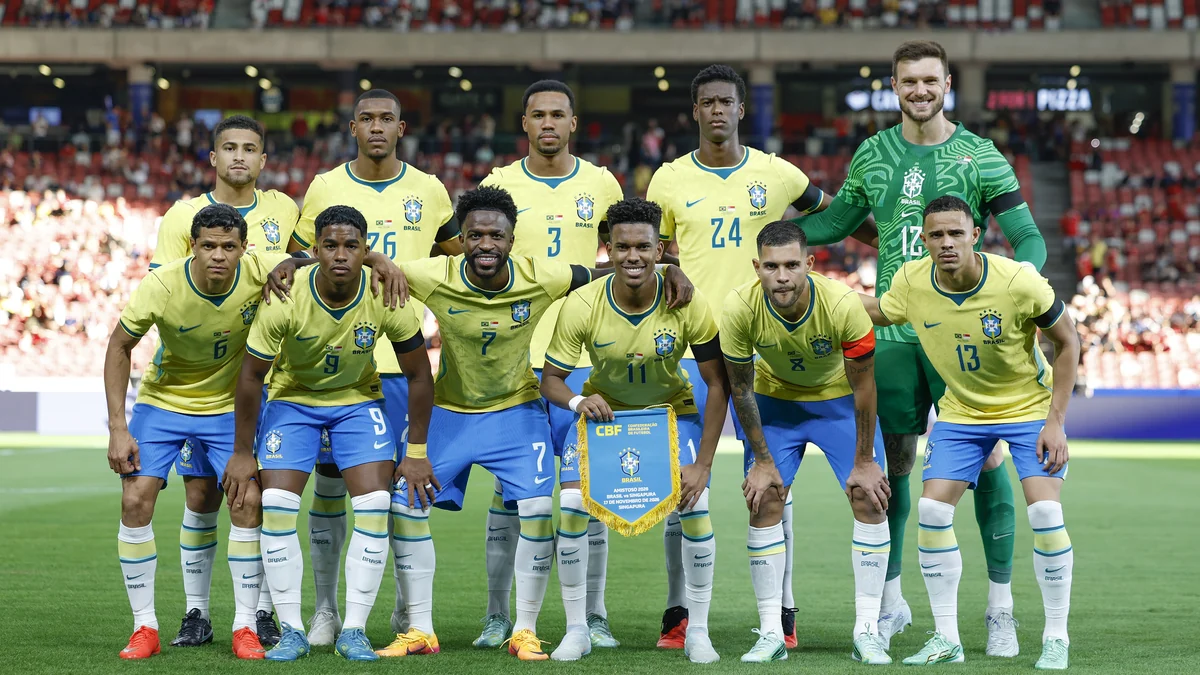
Brazil showed that it could press, accelerate after regaining possession and sustain its attacking output even after taking control in the 7–0 win over Singapore on November 17, 2026. It also introduced young players without bringing the attack to a halt. The result does not, however, prove that those mechanisms will work just as efficiently against elite national teams: the technical gap was enormous, and Singapore offered limited resistance in several decisive moves.
The press caused errors, not just territorial control
The most relevant collective sign was how Brazil reduced the opponent’s decision-making time. Singapore coach Gavin Lee said the speed of Brazil’s press left his players without space and made induced errors look like simple mistakes. CNA also reported that Singapore lost the ball while playing out before the opening goal and again in midfield in the move leading to the seventh.
That supports a specific conclusion: the press had a practical effect. This was not merely a team camped in attacking territory against a withdrawn opponent. Brazil shaped decisions, regained possession and turned some of those recoveries into chances.
There is an important caveat. Singapore escaped the press at times and created danger from wide areas, something Brazilian assistant coach Francesco Mauri acknowledged. A clean sheet therefore should not be treated as evidence of a flawless defensive performance.
Transitions gave the attack depth
The second goal captured another useful behaviour. According to the Brazilian Football Confederation’s account, the move began inside Brazil’s own half: Vinicius Junior carried the ball at speed, released Endrick and received the return pass to finish. CNA described Singapore pushing forward in search of an equaliser and being caught on the counterattack.
The tactical value lies in the sequence, not only in individual speed. There was a carry that drew defenders, a forward pass and a return ball inside the penalty area. Later, when Singapore again moved its lines higher, Brazil exploited the space left behind for Rayan’s goal.
These moments show that the team quickly recognised when to accelerate. They do not yet demonstrate how it would respond to an opponent that protected turnovers better, restricted space behind its defence and pressed the ball carrier with greater coordination.
The starting attack combined through different routes
Before the match, Ancelotti had confirmed Vinicius Junior, Estêvão and Endrick in attack. He also announced that Rayan would be tested in midfield as part of a process designed to identify what was working and what needed improvement. That explanation appears in the CBF’s pre-match interview.
On the pitch, the starting trio produced early through different mechanisms. Bruno Guimarães supplied Vinicius for the opener; the quick transition connected Vinicius and Endrick for the second; Estêvão found Vinicius inside the box for the third; and Endrick scored from outside the area. Estêvão added another early in the second half after a defensive error.
The variety is encouraging because the attack did not depend on a single pattern. The connections between the forwards can be carried into harder tests, but the frequency with which they found space and benefited from opposition errors is unlikely to be repeated.
The young players maintained the output after the changes
The coaching staff retained the starting side at the beginning of the second half and made four substitutions after 15 minutes. Allan, Vitor Reis, Marlon Gomes and Gabriel Bontempo came on, with Allan directly involved in the next two goals. He first played a diagonal pass for Rayan to beat the goalkeeper and score. He then added the seventh himself less than ten minutes after entering, according to the CBF.
The collective point is not to grade the substitute but to observe that the changes did not erase Brazil’s attacking intent. The team continued to attack space and regain possession. Allan found Rayan with a vertical pass, while the final finish followed another Singapore turnover in midfield.
That suggests the young players understood their assignments and the game’s tempo. A short appearance with the match already decided cannot establish that all of them are ready to reproduce the same impact under greater competitive pressure.
The 7–0 confirms execution, not definitive progress
CNA provided the scale of the mismatch: Brazil were sixth in the FIFA ranking, 143 places above Singapore. Although the hosts tried to build from the back instead of simply defending, they were exposed to an intensity their coach said they did not usually face. Singaporean coverage also reported that three more Brazilian goals were disallowed.
The score therefore supports proportionate conclusions. The press continued after Brazil established its lead; the transitions were coordinated; the starting attack created through different routes; and the substitutes sustained the output. Those are signs of serious execution in a highly uneven friendly.
The match did not test to a comparable degree Brazil’s build-up under a strong press, its defence against prolonged attacks or its ability to create when an opponent allows little space. Ancelotti had said the previous day that defensive aspects seen against Japan still required improvement. A rout of Singapore does not erase that diagnosis.
The most useful reading lies between euphoria and dismissing the test altogether: Brazil performed the tasks presented by this match well. Validation of the model will depend on repeating those behaviours with less time, less space and a greater price attached to every mistake.
Discover Becoartes
Art, culture and new conversations meet at Becoartes, Rua Gonçalo Afonso, 99, Vila Madalena, São Paulo. Learn more at [becoartes.com](https://becoartes.com/).
Becoartes - Beco do Batman
99 Gonçalo Afonso Street, Vila Madalena, São Paulo