What does a child hear when it begins to rain again? In a coastal city that has lived through two hurricanes, the answer need not be the same as it was before the first one. A mother in Guerrero told UNESCO that her son came to associate ordinary rain with the arrival of another hurricane. She also watched him grow interested in painting after a workshop on traditional masks and figures. Both details belong in a history of the recovery. Only one of them would be visible to someone taking stock of repaired buildings.
Horizontes de resiliencia, a feature documentary made by filmmakers from Guerrero, is taking that distinction to audiences across Mexico. UNESCO announced an itinerary of 25 cities in 15 states on November 25. It includes a cinema in Monterrey, a high school in Matamoros and a university laboratory in Tampico. A visit to a classroom and a night at the movies may sound like very different uses of a film. Here they are part of the same invitation: listen to the people who stayed after the cameras documenting the disaster moved on.
Two hurricanes, not one closing chapter
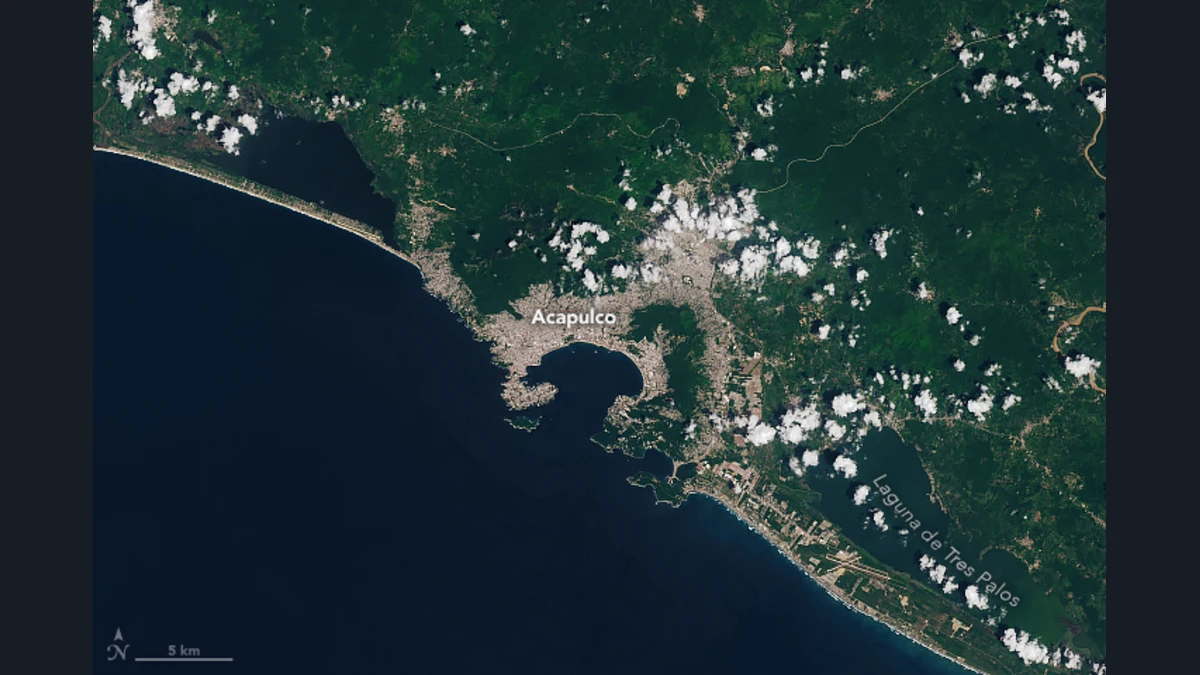
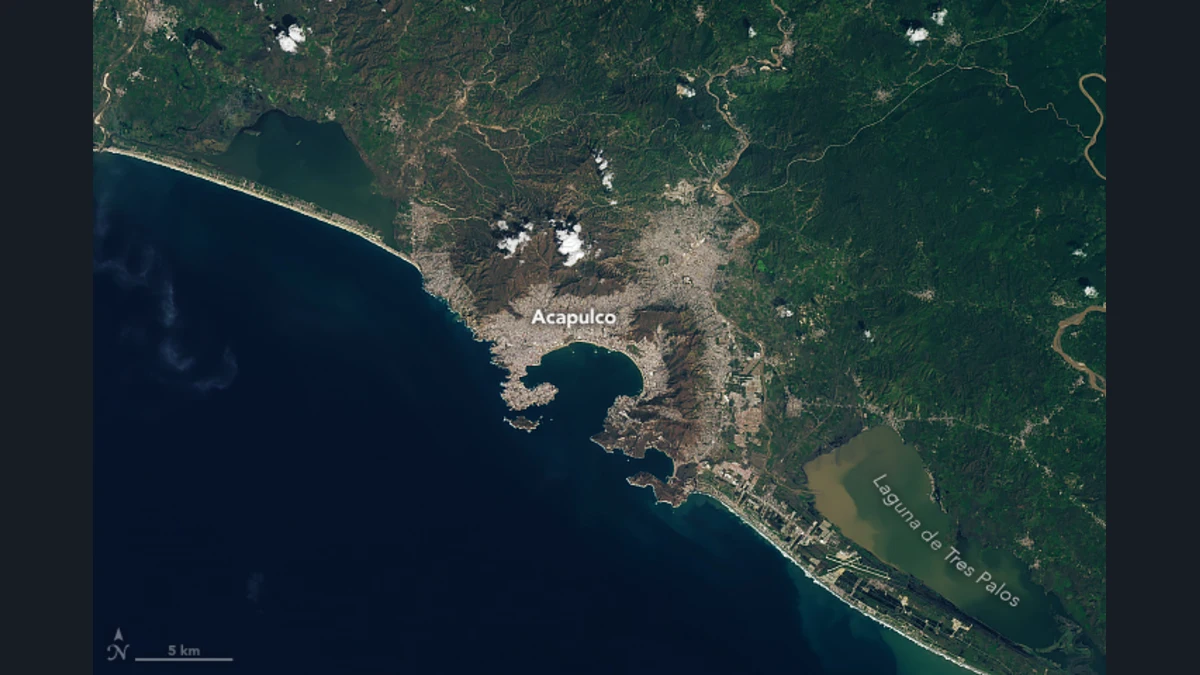
The starting point is October 25, 2023, when Hurricane Otis struck near Acapulco. One way of understanding how quickly expectations changed that day is to look at the record from NASA’s Earth Observatory. In just over twelve hours, Otis went from a tropical storm to a Category 5 hurricane. Landsat observations from September and late October show a green landscape around the bay turning brown. The second image, taken almost a week after landfall, still shows sediment washed into Laguna de Tres Palos.
These are archive images, not scenes from the documentary. They are valuable precisely because of the limits they expose. A satellite can record changes in the canopy across a wide area; it cannot tell us what a family did when clouds gathered the next time. Hurricane John struck Guerrero in 2024. That second emergency matters to the structure of the story. Recovery from the first storm was not something residents could finish, catalogue and put away before the next one arrived.
What can fit inside a fanzine
In Acapulco and Coyuca de Benítez, artists and cultural workers organised more than 200 workshops, mainly for children. A fanzine is a small publication its makers can write, illustrate and put together themselves. Ismael Polanco, a young participant in Acapulco, described how creating one led him to write about feelings that did not all have to do with a hurricane. For an audience coming to the film for a disaster story, the last part of that observation is especially worth hearing.
The page does not require a young person to be a witness to a catastrophe every time he speaks. He can decide which story to tell and which to keep. A mask offers another kind of distance: a child can work with colour and shape without having to give an adult a chronological account of a frightening night. Neither activity is a substitute for shelter, medical treatment or a functioning school. Nor is one family’s experience a clinical measure of the impact of the workshops. It is a reason to ask participants themselves what changed.
The people behind the camera
Director Héctor López Taboada belongs to Trashumantes, the independent film collective from Acapulco that produced the film with UNESCO. Diego Alan Santos Castro shared the cinematography; María Candelaria Palma Marcelino co-edited the film with the director; Karlos Morales composed the music. The distinction between a film made *about* a place and a film made by people *from* that place is not merely a matter of credit. It affects whose work the audience can follow once the tour leaves town.
One useful question to take into the screening is who gets to define the end of an emergency. The arrival of electricity might mark one ending; the day a parent hears her child talk about rain differently might mark another. A documentary can hold those clocks side by side without deciding that one cancels the other.
Where the film is scheduled next
UNESCO lists two performances at the Cineteca Nuevo León Alejandra Rangel Hinojosa in Monterrey, both in Screen 2: November 26 at 8 p.m. and November 27 at 6 p.m., local time. In Tampico the announced date is November 30 at 2 p.m., at the film production and management laboratory of the Universidad Autónoma de Tamaulipas. The Biblioteca Central Estatal Wigberto Jiménez Moreno in León is listed for December 3 at 4 p.m.
A date in the national programme is not a reservation or a guarantee that a public seat is available, particularly at educational venues. Check the host’s entry arrangements before travelling. For readers outside Mexico, the itinerary is a guide to the physical tour, not an announcement of a Brazilian theatrical release or a streaming launch. What travels on this circuit is something more specific than a story about storm damage: the work that people in Guerrero chose to do together after the wind had passed.
Image credits. Images resized, framed with margins and converted to WebP without cropping. Michala Garrison / NASA Earth Observatory; Landsat data: USGS (NASA Earth Science imagery: editorial republication permitted); Michala Garrison / NASA Earth Observatory; Landsat data: USGS (NASA Earth Science imagery: editorial republication permitted).
Sources for this story
Original documents are linked in the article.
Becoartes - Beco do Batman
99 Gonçalo Afonso Street, Vila Madalena, São Paulo