If you are buying a costume at the last minute, make seven checks while you are still in the store: flame-resistance labeling, length and fit, field of vision, visibility after dark, the makeup’s intended use, the cosmetic’s condition and the source of decorative contact lenses. Some shortcomings can be fixed; others are reasons to leave the product on the shelf.
The regulatory guidance below applies to the United States. It is intended for shoppers using US stores and should not be treated as a rule for other countries.
1. Look for flame-resistance labeling
Start with the label on the clothing, cape, wig and other textile pieces. The FDA recommends costumes labeled “flame resistant”. For a homemade costume, its guidance names flame-resistant fabrics such as polyester or nylon.
The CPSC’s October 12, 2026 update summarizes the inspection as fit, visibility and fire safety. If a purchased item carries no clear label information, do not assume the manufacturer intended a property it did not state. When in doubt, choose another, properly labeled option.
Decision: keep an appropriately labeled item; skip one whose safety depends on an assumption.

2. Test the length, fit and loose parts
Put on the costume and walk a few steps. The hem should not fall beneath the feet or create a tripping risk. Federal guidance says costumes should not be so long that the wearer may trip. Also check whether sleeves, tails, capes and accessories remain in place during normal movement.
A length problem may be fixable before use if the fabric can be secured or adjusted firmly. If the size is far off or an accessory keeps coming loose, exchanging the product is the simpler decision.
Decision: fix a hem that can be secured safely; skip an unstable or unsuitable fit.

3. Check a mask’s vision and ventilation
Place the mask in its actual wearing position and look ahead and to both sides. If it prevents the wearer from seeing the route, other people or vehicles, it is not a good choice. The FDA recommends makeup and hats instead of costume masks that obscure vision.
Make a practical check of breathing and stability as well: the mask should not slide over the eyes when the wearer turns their head. Do not compensate for poorly positioned openings by wearing it in a way the product does not indicate.
Decision: replace a mask that limits vision; skin-appropriate makeup may be an alternative.
4. Plan for visibility after dark
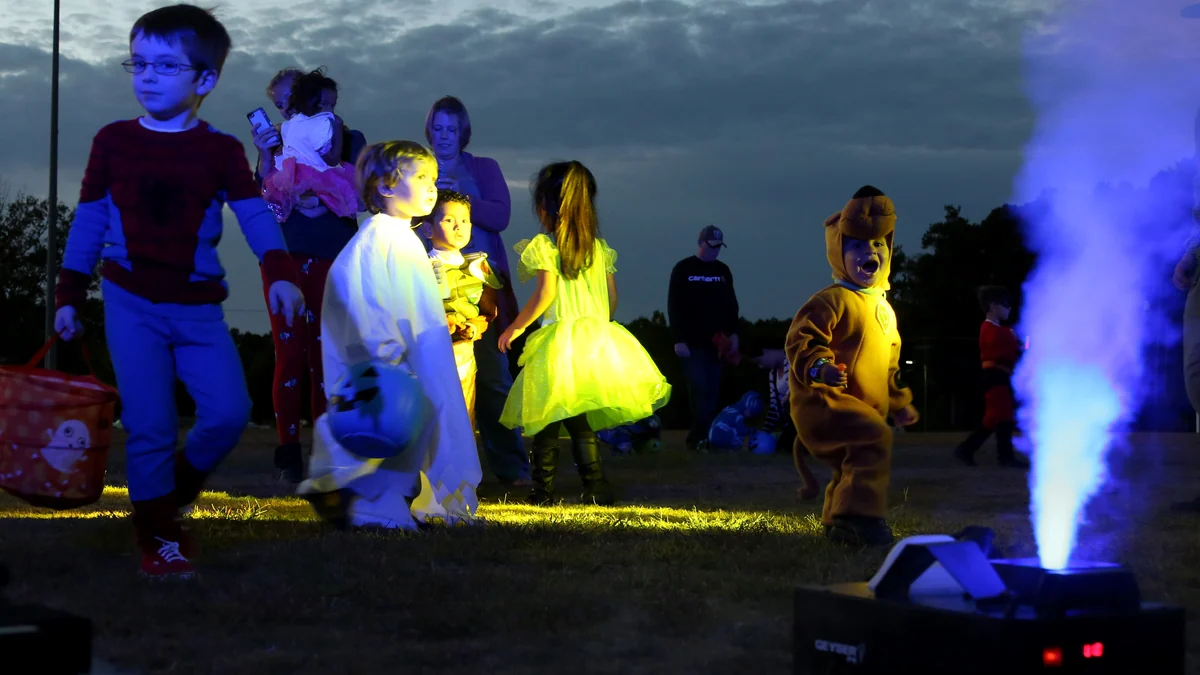
Dark colors can blend into a nighttime setting. FDA guidance recommends bright or reflective costumes, or adding strips of reflective tape. A dark outfit therefore does not automatically need to be rejected if reflective material can be added securely and visibly.
Before paying, consider the complete outfit rather than only its appearance under store lighting. Decide where tape can be attached without coming loose or restricting movement.
Decision: fix the problem with firmly attached reflective elements; skip a solution that remains hard to see.
5. Read where makeup may be applied
“Made for skin” does not necessarily mean “made for the eye area.” The FDA’s novelty makeup guidance says to follow all directions and never decorate the face with materials not intended for skin. If the label prohibits use near the eyes, follow that restriction even when the package shows the product used there.
Check the ingredient list and the permitted use of color additives. The FDA notes that a color allowed for nails or hair may not be permitted on skin or around the eyes.
Decision: keep only a product intended for the area where it will be used.
6. Inspect the cosmetic and schedule a patch test
A very bad smell may signal contamination; FDA guidance says to throw that product away. For makeup the wearer has never used, apply a small amount to the arm in advance. General Halloween guidance specifies 24 to 48 hours and says to watch for a rash, redness, swelling or another sign of irritation.
That makes a last-minute purchase less flexible: if there is no time for the test, do not treat the absence of an immediate reaction as a guarantee. Follow the label’s removal instructions and do not sleep in the makeup.
Decision: skip a product with an abnormal odor or unsuitable directions; test it beforehand when time allows.
7. Do not buy decorative lenses as a simple accessory
In the United States, decorative contact lenses are medical devices even when they do not correct vision. The FDA says every contact lens requires a prescription and advises against buying them from a Halloween store, novelty store, flea market, street vendor or unknown supplier.
A lawful seller should request the prescription and verify it with the prescriber. An eye exam, proper fitting, and cleaning and wearing instructions are part of the process. Lenses obtained or used incorrectly can cause corneal abrasion, allergic reactions, decreased vision, infection and blindness. For redness, persistent pain, discharge or decreased vision, the FDA advises removing the lenses and immediately seeing a licensed optometrist or ophthalmologist.
Decision: without a valid prescription and professional verification, do not buy.
The final check before checkout
Sort your findings into three groups. Keep products with appropriate labels, a sound fit and clearly indicated use. Fix before wearing a manageable hem or poor visibility that can be addressed with firmly secured reflective tape. Leave behind masks that obstruct vision, cosmetics unsuitable for the intended area, products with an abnormal odor and lenses offered without a prescription.
This short inspection keeps a rushed purchase from becoming guesswork by focusing the decision on risks that can be noticed before payment.
Discover Becoartes
Becoartes is at Rua Gonçalo Afonso, 99, Vila Madalena. Confirm the address on the [official website](https://becoartes.com/).
Becoartes - Beco do Batman
99 Gonçalo Afonso Street, Vila Madalena, São Paulo
Sources and credits
- Cpl. Jason Jimenez — Public domain
- Airman 1st Class Christian Clausen — Public domain
- Airman 1st Class Christian Clausen — Public domain
- CPSC — Scary Costume, Safer Halloween (12 de outubro de 2026)
- FDA — Halloween Safety Tips: Costumes, Candy, and Colored Contact Lenses
- FDA — Decorative Contact Lenses for Halloween and More
- FDA — Novelty Makeup
- Just Halloween Crafts — Last-Minute DIY Halloween Costumes From Things You Own