Anyone researching an international KCON should begin with an important distinction: the brand retains a recognizable concept, but it does not deliver an identical experience in every country. Concerts, artists, meetups and Korean-culture areas depend on the edition. A reliable comparison must therefore use announcements for the same city and year—information from one destination should never simply be transferred to another.
What remains consistent in the KCON concept
CJ ENM defines KCON as a large event combining a K-pop concert and a K-Lifestyle convention. Its description encompasses music and other areas of Korean culture, such as food, beauty and story-based content. This combination explains why KCON should not be understood solely as a sequence of musical performances.
There is, however, a difference between an institutional concept and an event schedule. CJ ENM’s page explains the initiative’s reach, but it is not a detailed timetable for each edition. To learn which artists, sessions or experiences will be available, readers must consult the channel dedicated to their chosen event.
Los Angeles 2026: an identified edition, not a universal template
In the material reviewed on September 16, 2026, the KCON USA website highlighted KCON LA 2026 and displayed a dedicated lineup section, special guests and ticket links. The available extract, however, did not preserve artist names or participation conditions. This article therefore does not reproduce a roster that cannot be confirmed by name in the supplied source.
Los Angeles illustrates how an edition receives its own communication. It does not establish that artists, guests, tickets or access formats are the same in Japan, France, Mexico or any other market. Even details visible on an official page may change; final confirmation should be made on the edition’s website before making plans.
Jeju 2015 and LA 2026 represent different moments
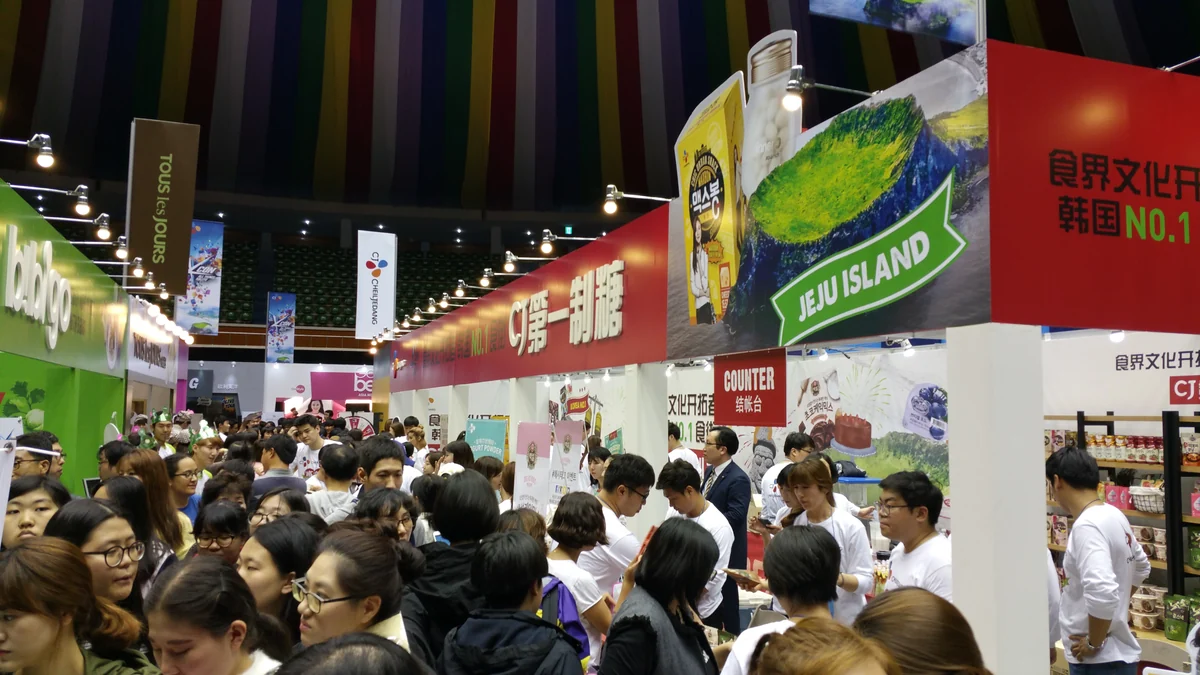
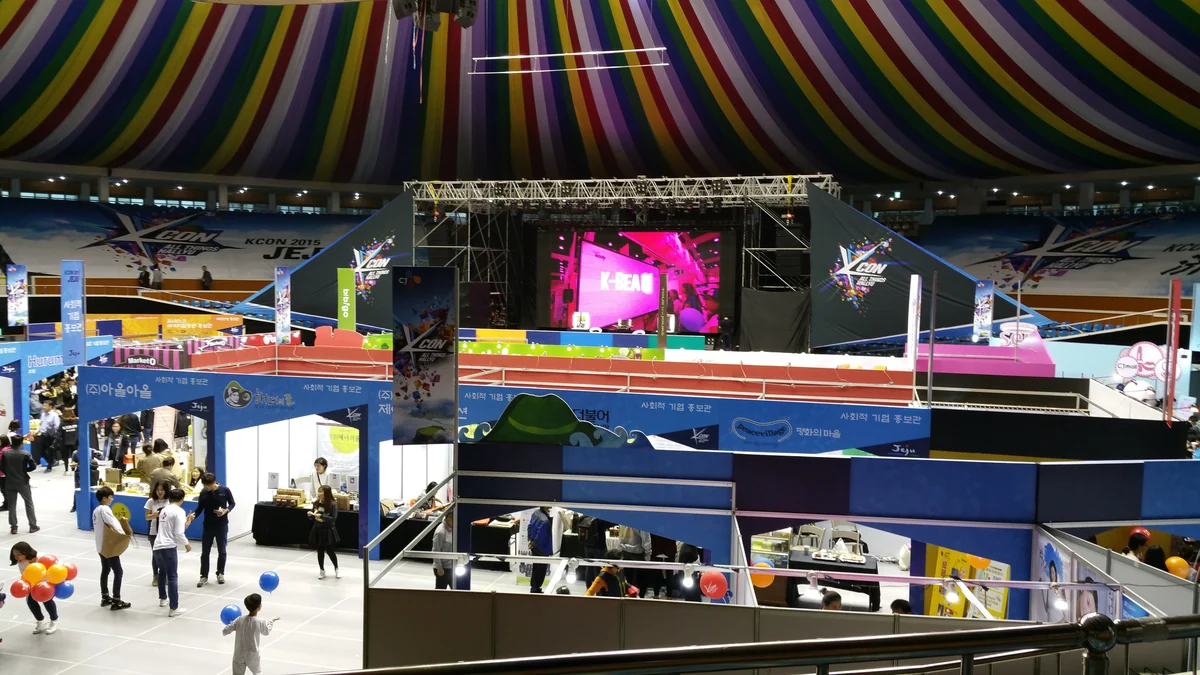
The attached photographs document the KCON Jeju convention held on November 7, 2015, at Jeju Stadium in South Korea. They show crowded aisles, commercial and cultural booths, and a stage structure inside the hall. These are historical records that help illustrate the convention side of the brand, not evidence about a current edition.
The available comparison with Los Angeles 2026 is specific: Jeju is represented by historical visual documentation of its convention floor, while LA appears through a current page announcing a lineup, guests and ticket sales. The supplied sources do not support comparisons of artist names, times, prices or meetup formats. That limitation matters: older images explain the format but cannot replace a current program.
International expansion did not create one shared schedule
According to CJ ENM, KCON launched in the United States in 2012 and has reached more than 2.35 million people across 14 regions, including Japan, France, Mexico, Australia, Thailand and Saudi Arabia. The company also presents the event as a platform for artists, small and medium-sized enterprises, and K-Lifestyle brands.
That reach helps explain the range of possible components, but it does not prove that all of them appear in every city. A K-Food area photographed in Jeju, for example, does not confirm an equivalent activity in Los Angeles. Likewise, institutional references to K-Beauty or K-Story describe KCON’s broader repertoire, not a promise for every edition.
The industry behind the circulation of K-culture
KCON’s international presence belongs to a larger ecosystem. KOCCA, South Korea’s public content-industry agency, says it supports production, distribution and international expansion in music, audiovisual media, games, fashion, animation, comics and convergent technologies. It also operates business centers in cities across several countries, including Los Angeles, Tokyo, Paris, Mexico City and São Paulo.
This provides context for the global circulation of Korean culture, but it does not make KOCCA a source for KCON lineups. Each institution should be consulted for what it actually publishes: KOCCA helps explain industry infrastructure, while KCON’s organizers confirm their event programming.
Digital content must also be separated from the physical event
Mnet Plus features upcoming livestreams and K-pop programs, including artist content and productions connected to Korean music. An artist’s or program’s presence on the platform, however, does not confirm participation in KCON.
To avoid confusion, it is useful to separate three layers: the edition page confirms the physical event; the platform describes its digital offering; and official profiles publish updates. Fan posts, old schedules and videos from previous years may support research, but they should not be presented as current confirmation.
How to compare destinations using verifiable information
Before choosing an edition, look on its corresponding page for four elements tied to the same city and year: a named lineup, activity descriptions, ticket rules or categories, and recent notices. If an element has not been published, the accurate conclusion is that it remains unconfirmed.
The date of each item also matters. A 2025 recap, a photograph from Jeju 2015 and a page for LA 2026 serve different purposes. Together they illustrate KCON’s development and breadth; individually, none describes every global edition. Programs and conditions are subject to change, so check them again through the official channel for the selected destination.
Continue the cultural conversation at Becoartes
For more perspectives on music, cinema and culture, visit Becoartes at Rua Gonçalo Afonso, 99, Vila Madalena, São Paulo.
Becoartes - Beco do Batman
99 Gonçalo Afonso Street, Vila Madalena, São Paulo