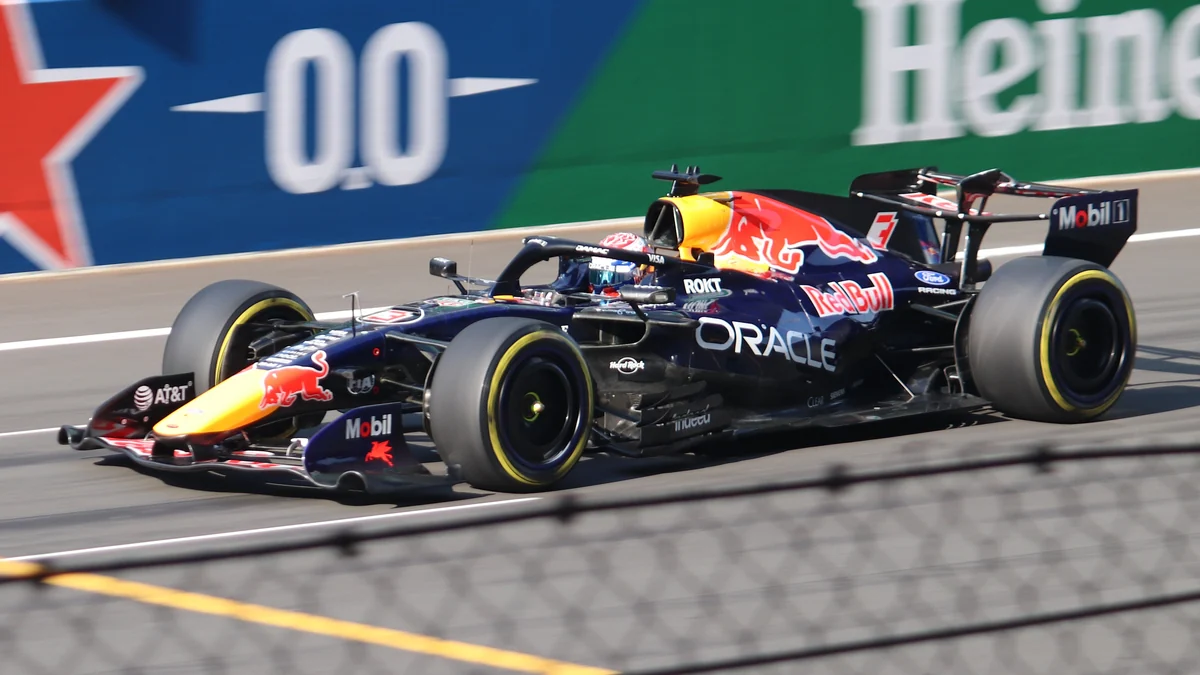
Max Verstappen received no penalty because the stewards concluded that he responded appropriately to the yellow flag, even though he overtook Lewis Hamilton inside the flagged sector. Telemetry showed that the Red Bull driver fully lifted off the throttle and reduced his speed; according to the decision, the pass was a consequence of the large speed difference between the cars. Verstappen therefore kept pole position for the 2026 Singapore Grand Prix Sprint.
What happened in SQ1
A single yellow flag was shown after Cadillac’s Sergio Perez hit the barrier. Verstappen was on a push lap exiting Turn 7, with Hamilton ahead of him. The Ferrari driver, who had been warned that the Red Bull was approaching, slowed and moved to the right, away from the racing line.
Verstappen passed Hamilton before Turn 8 while both cars were still inside the yellow-flag sector. Hamilton drew attention to the move over the radio. Verstappen said he believed the pass had been completed before the flag but announced that he would give the place back as a precaution. He also abandoned the push lap.

An investigation does not automatically mean a penalty
The incident was investigated only after the session. The FIA decision-document page records a summons concerning Car 3, followed by the yellow-flag infringement decision. That sequence helps distinguish three stages: an allegation, a hearing and a verdict.
The hearing confirmed a breach of the regulation because the overtake occurred in the yellow sector. That finding, however, did not require the stewards to issue a penalty without considering the circumstances established through testimony and car data.

What the telemetry showed
According to Formula 1’s official account, Verstappen fully lifted off the throttle approximately 40 meters after entering the yellow sector. At the point of the pass, his speed was about 70km/h lower than it had been on another push lap in the same session.
Hamilton, meanwhile, had braked and was traveling at less than 60km/h. Because Verstappen had been accelerating out of Turn 7 before seeing the flag, the closing-speed difference remained substantial even after he began braking. The stewards also accepted that braking extremely hard to prevent any overlap could have created an unsafe situation.
Why there was a breach but no sanction
The key distinction is between the objective act and the driver’s response. Overtaking inside the yellow sector constituted the breach. When deciding the consequence, the stewards found that Verstappen lifted, slowed and abandoned his push lap—actions consistent with responding to the signaled danger.
The pass was not treated as an attempt to gain an advantage, but as an unwanted result of Hamilton’s much sharper deceleration. The decision therefore formally recognized the infringement while imposing no penalty in those circumstances. It did not declare that no rule had been broken.
How the ruling affected the grid
With no loss of position, Verstappen retained his 1:31.156 time and first place in Sprint Qualifying. The official Singapore Grand Prix page lists George Russell second in 1:31.276 and Charles Leclerc third in 1:31.399.
The FIA also published the final session classification, the provisional grid and, on October 10, the final Sprint grid. The ruling’s direct sporting consequence was therefore to keep Verstappen in the first grid position, ahead of Russell and Leclerc. Check the FIA page for later versions of the documents or any official changes.
The terms in four languages
In English, the relevant terms are *yellow flag*, *investigation*, *infringement* and *penalty*. In Brazilian Portuguese, they are *bandeira amarela*, *investigação*, *infração* and *punição*. Spanish uses *bandera amarilla*, *investigación*, *infracción* and *sanción*, while French uses *drapeau jaune*, *enquête*, *infraction* and *pénalité*. The difference between an infringement and a penalty is essential here: the first was established; the second was not imposed.
Discover Becoartes
Visit [Becoartes](https://becoartes.com/) at Rua Gonçalo Afonso, 99, Vila Madalena, São Paulo.
Becoartes - Beco do Batman
99 Gonçalo Afonso Street, Vila Madalena, São Paulo