Designing a staircase usually means answering two questions: how to bridge a difference in height and where to put the next foot. On the public passage between Rua Medeiros de Albuquerque and Rua Patápio Silva in Vila Madalena, a third question came into play. What belongs on that narrow vertical strip beneath each step? At the Escadaria do Patápio the answers include drawings, words and the handiwork of people who attended a tile workshop. This is one of the most interesting pieces of public art around Beco do Batman precisely because it never stopped being a shortcut. You can walk right through it on your way to something else.
A Saturday set in ceramic
In August 2015, during São Paulo’s Design Weekend, the passage between the two streets became the site of a project involving Ateliê Azu, tile manufacturer Eliane and cultural outlet Catraca Livre. In an account published on August 19, Eliane recorded a revealing detail: people attending the opening could decorate tiles at a workshop. They were not simply invited to unveil something that had already been finished. They were given the rare opportunity to take an undecorated surface and decide what it should become.
Consider the decisions that involves, without trying to assign a particular tile to a particular hand. Can a whole sentence fit inside a square? Will a thick line leave room for the one that follows? Will words that look perfectly legible on a table still make sense from the street? A drawing on an uninterrupted wall can spread out as it goes along. With a tile, the edge is there from the first stroke. Once the pieces are assembled, what looked like a severe restriction becomes the organizing principle of the entire work.
Two staircases in the same place
Approach the stairs from below and you look straight at the risers: the vertical faces separating one step from the next. Go down and you tend to look instead at the treads, the horizontal surfaces on which your feet will land. The same stretch of street offers different experiences depending on the direction of travel. There is no need to remember the architectural terms to notice the effect. Compare the designs facing you at the bottom with the series of lines that catches your eye from above.
A mural also changes with viewing distance, but there is a difference here. With each step the viewer’s body rises or falls. A detail that seemed almost at eye level moves past your knees and soon ends up behind you. The flight of steps sets the sequence but not the pace. A neighbour in a hurry and a child puzzling out a word may cover the same distance without seeing quite the same work.
Giving the street punctuation
São Paulo’s Pinheiros district administration describes the tiles as a combination of art and poetry. On a printed page the reader controls the distance between words and eyes. On a staircase the location of a word goes some way towards choosing that distance for you. A gap between two units can read as a pause. A drawing can interrupt a line of thought much as a short verse interrupts a conversation. There is no need to extract a secret message from the whole. Different voices taking up different squares already give the work a subject.
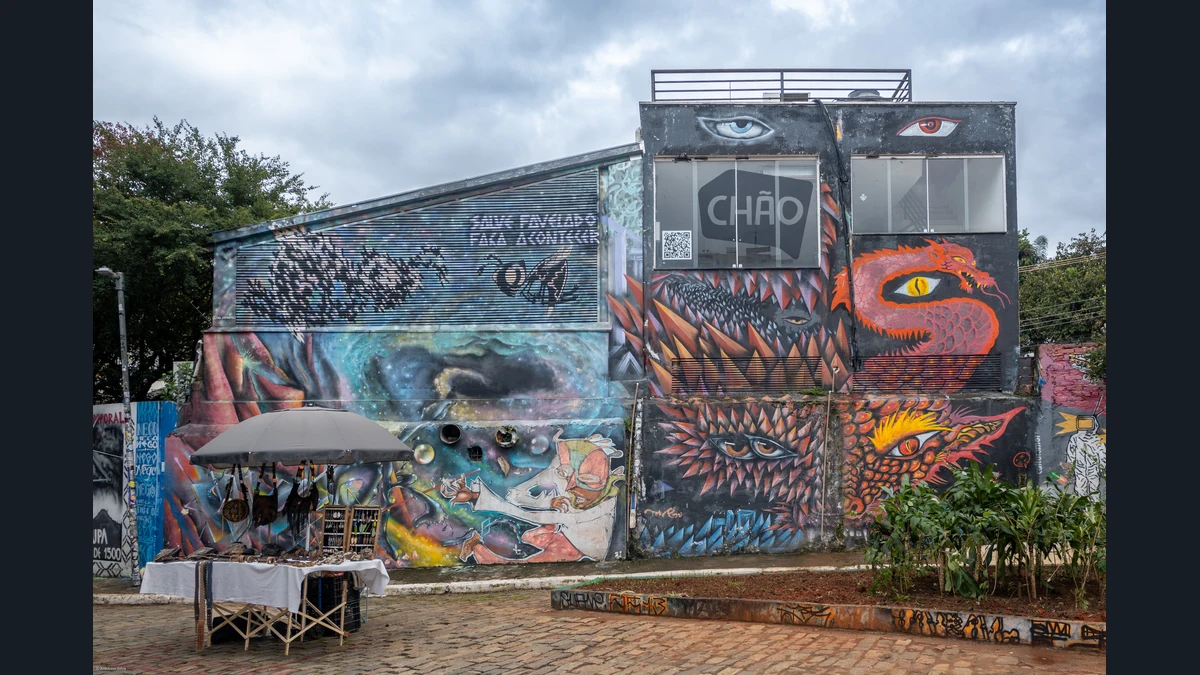
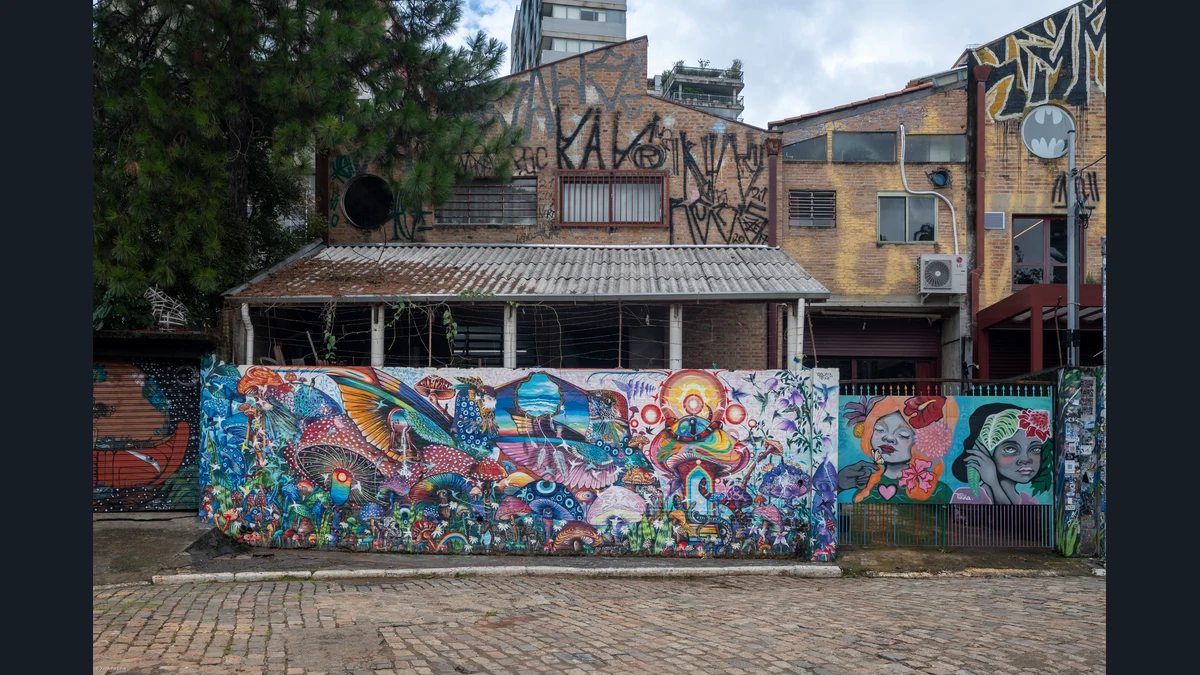
That distinction matters beside the murals for which Beco do Batman is known. A mural can take a single image to the scale of a building. The stairs work from the opposite end: they take units small enough to hold in one hand and add them together until they reach the scale of a street. Neither is a reduced version of the other. They offer different answers to the same question: how do you make art visible to people who did not necessarily leave home to look at art?
A work that does not ask for silence
A public passage cannot welcome its viewers like a gallery with a prescribed distance between the audience and the work. Stopping for a closer look means leaving space for someone else to get by. Respecting that practical purpose takes nothing away from the experience. In fact, it reveals why the idea makes sense here. The staircase already served a purpose before the tiles arrived. Continuing to connect two streets is as important to the outcome as the choice of ceramic.
The opening account tells us what happened that weekend; it does not promise that every tile has stayed intact since. That distinction matters in a city whose images from different years circulate side by side as if they were all taken this morning. What does not require a matching photograph to recognize is the idea: a link between two addresses can also preserve an encounter between strangers. At Patápio the best frame for the story is not a frame at all. It is the next step.
Image credits. Context photographs resized, framed with margins and converted to WebP without cropping. xiquinhosilva / Wikimedia Commons (CC BY 4.0); xiquinhosilva / Wikimedia Commons (CC BY 4.0).
Sources for this story
Original documents are linked in the article.
Becoartes - Beco do Batman
99 Gonçalo Afonso Street, Vila Madalena, São Paulo