Want to discover São Paulo’s Theatro Municipal without depending on a ticket to a performance? There are three complementary routes: observe the building as a document, join an educational activity and consult the records preserved by the complex itself. Each reveals a different layer—form, mediation and memory—and can guide either a first visit or deeper research.
The arrival address provided by the Municipal is Praça Ramos de Azevedo, s/nº, Sé, São Paulo. Because schedules, routes, bookings and capacity may change, confirm the conditions on the official visits and educational activities page before setting out.
1. Read the building before seeking explanations
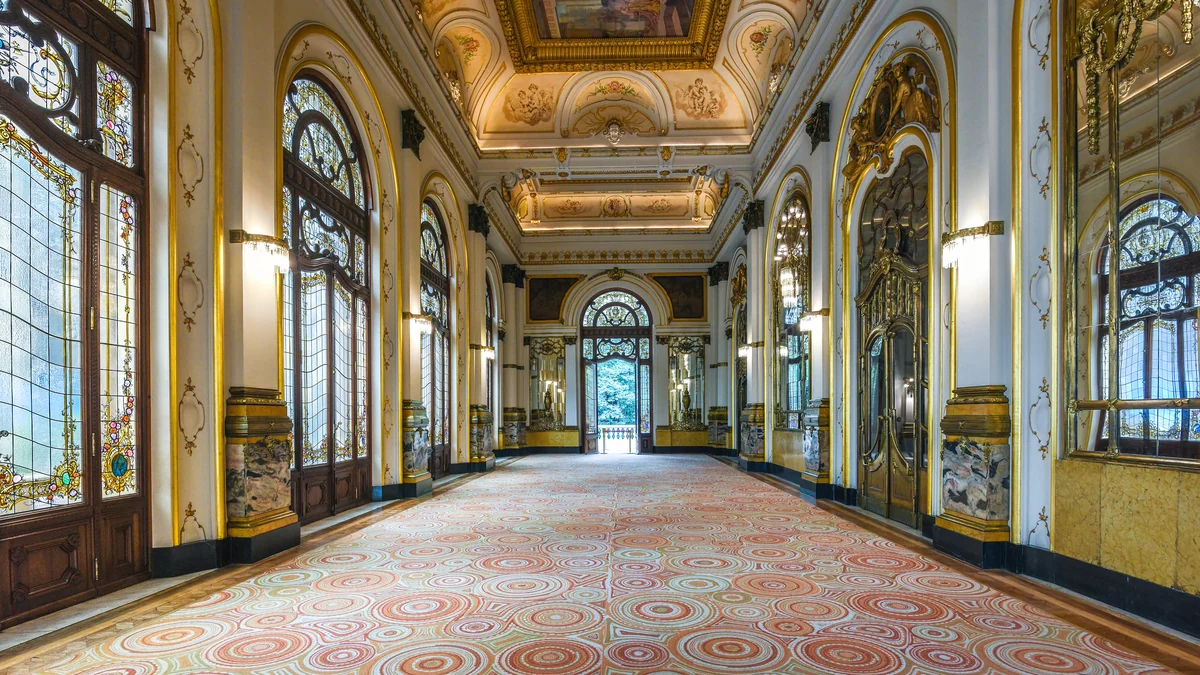
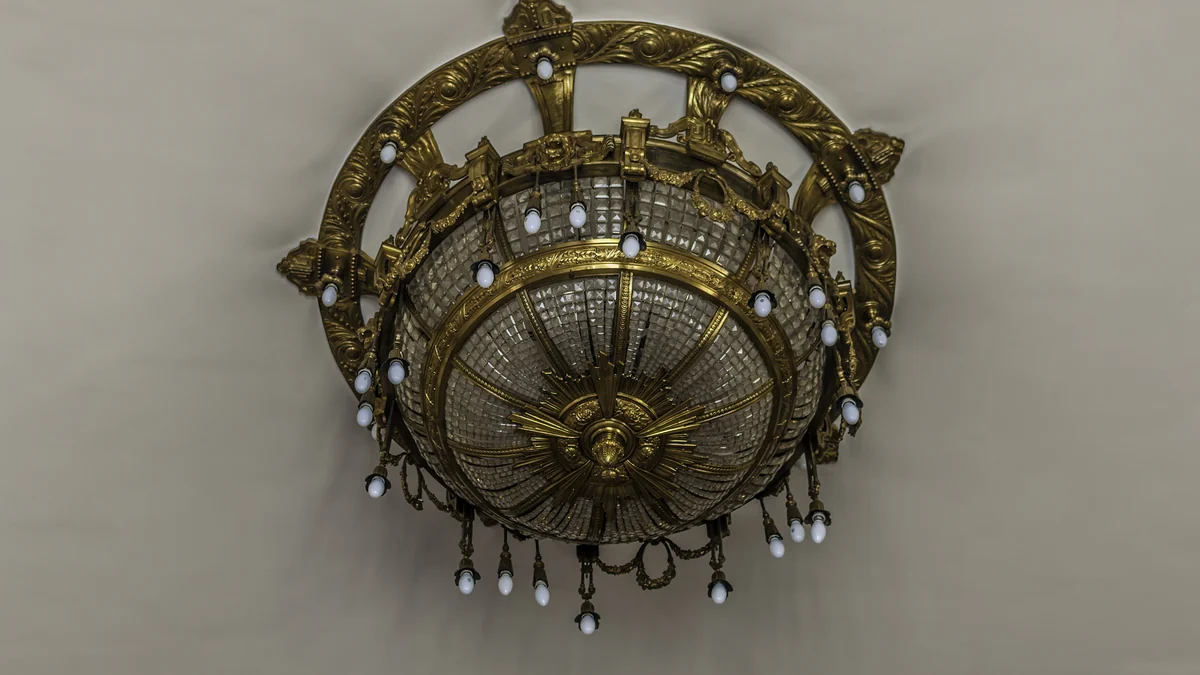
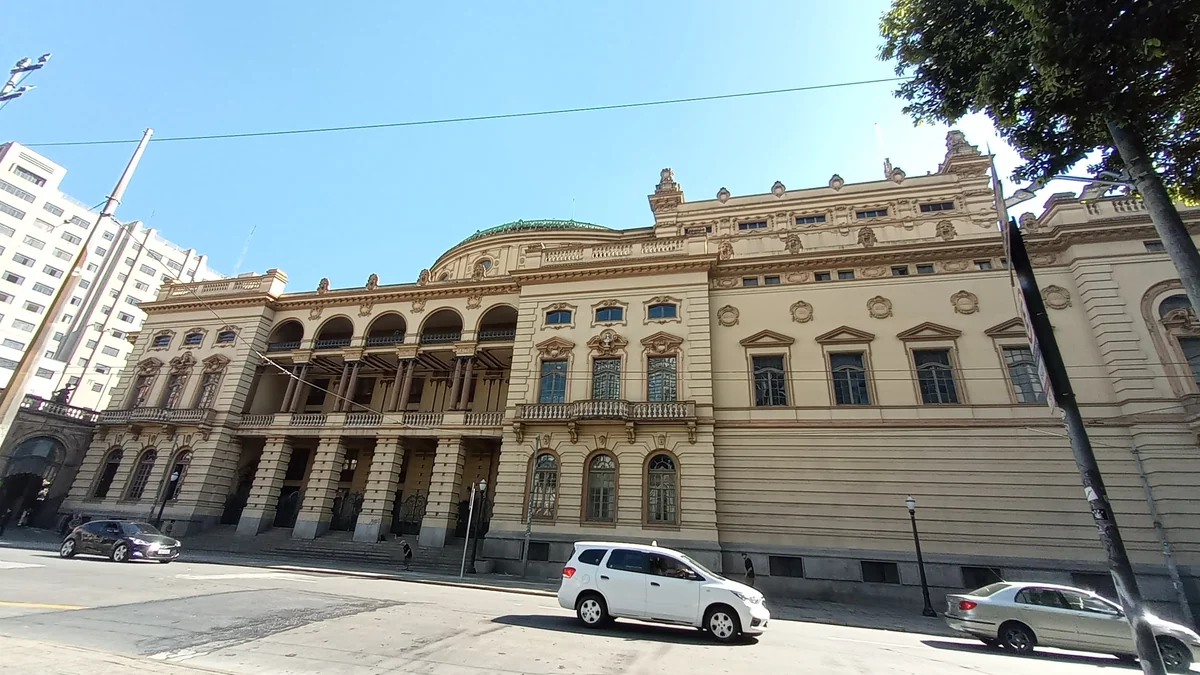
Begin by slowing down. Instead of trying to record everything, choose a sequence: façade, entrance, circulation areas, ceiling, doors, lighting fixtures and surfaces. Notice repetition, contrast and changes of scale. Ask which elements guide visitors, which are purely ornamental and which turn movement between spaces into a ceremonial experience.
The interior gallery photographed in this article, for example, makes it possible to compare stained glass, gilded frames, panels, mirrors, doors, columns and the floor’s circular pattern. The exercise does not require assigning materials, makers or dates without documentation: simply distinguish what the image shows from what still needs research.
This approach also prevents “marble” from becoming a complete explanation for monumentality. Stone-like surfaces, metallic shine, colored glass, light and pattern work together. Photographing or noting a detail and then searching for it in the collection portal produces a more precise question than simply looking for “theater history.” The Municipal’s institutional website provides general context for the building and confirms its address.
2. Free circulation: a first encounter
The Theatro de Portas Abertas program allows visitors to encounter the architecture and artistic elements through the free-circulation option described by the institution, without prior registration. The page says this circulation is concentrated in the lobby; on Saturdays, certain activities may provide access to other spaces, with registration on site and limited capacity.
This format suits those seeking a brief, independent observation. It does not mean unrestricted access to the building: the available rooms depend on the activity and the day’s organization. The published program also mentions observational drawing, a table displaying photographs and newspaper clippings, and activities involving costumes from the collection.
Days, times and formats are subject to change—and the page itself presents timing information that should be checked directly before a visit. Also verify whether an activity will take place, how to participate and which spaces it will include.
3. Educational visit: context and dialogue
Educational visits pass through principal spaces in the complex and explore historical and artistic content through dialogue with groups. Compared with free circulation, their advantage is mediation: questions raised by the architecture can be discussed along the route, without reducing the experience to a list of styles and dates.
The institution distinguishes visits in Portuguese, group appointments, visits in Libras—Brazilian Sign Language—and visits in English. Each has its own booking or scheduling rules; the English option, for example, is described as intended for foreign visitors and conditional on presenting identification and a passport in person. Do not assume that one rule applies to every format.
The Education Department also provides a map for schools and educators, designed to encourage observation of the historic building, its surroundings and its memory. Even for people outside a school group, the proposal offers a useful editorial key: notice nuances and accommodate multiple voices in interpreting heritage.
4. Thematic visit: when the question precedes the route
Thematic visits, games and storytelling sessions vary with the program. There are proposals for children and families as well as activities for general audiences, connecting the Theatro with social, artistic and heritage questions and with its urban surroundings.
Formats described by the institution include a walk examining art and cultural movements around the building; a visit encouraging new perspectives through Brazilian Sign Language; a role-playing game inspired by the 1911 inauguration; and an activity about the different people and forms of knowledge involved in producing a performance. Some are listed only as “next visit coming soon.” They therefore illustrate the program’s range, not a promise of current availability.
Choose this route when you already have a question: how does the theater relate to the city? Who works to make a production possible? Which memories does the monumental narrative leave in the background?
5. The collection: extending what a visit cannot show
The Collection and Research Department manages the São Paulo Theatro Municipal Complex’s documentary, iconographic, audiovisual and costume collections. Items are housed in the historic building, the Documentation and Memory Center at Praça das Artes and the Chico Giacchieri Technical Center for Artistic Productions in Canindé.
Some material is accessible through the portal; specific research can be requested through the form linked on the page. This route serves researchers, artists, students and other interested people. Before submitting a request, define a subject, period, person, performance or document type: precision helps turn curiosity into a feasible investigation.
The Índice de Fontes collection demonstrates the cultural value of this route. Its four volumes address traces of the 1922 Modern Art Week, Black presence, the Ballet IV Centenário, and women’s trajectories and gender studies. These perspectives shift attention from the monumental building to people, disputes and presences recorded—or made less visible—across more than eleven decades of institutional history.
6. How to combine the three routes
For a first encounter, observe the façade and use the circulation option officially available. Next, select an educational or thematic visit to compare your initial reading with other perspectives. Finally, search the portal or formulate a collection request around a detail you encountered.
The method turns contemplation into research: see, ask, document. Before going, confirm the address, rules, schedule, booking requirements and availability on the Theatro’s website. After the historic center, anyone wishing to continue a cultural route through São Paulo can visit Becoartes at Rua Gonçalo Afonso, 99, Vila Madalena, the address provided on the Becoartes website.
Keep looking at the city through its layers
Becoartes is at Rua Gonçalo Afonso, 99, Vila Madalena—an address where, in another context, the conversation between art, space and memory can continue.
Becoartes - Beco do Batman
99 Gonçalo Afonso Street, Vila Madalena, São Paulo
Sources and credits
- Wilfredor — CC BY-SA 4.0
- Wilfredor — CC0
- Lucassilva.123lucasa — CC BY 4.0
- Roberta Selymes — CC BY-SA 4.0
- Theatro Municipal — história do edifício e maneiras de conhecê-lo
- Theatro Municipal — visitas educativas, temáticas e Portas Abertas
- Theatro Municipal — Núcleo de Acervo e Pesquisa
- Centro de Referência — ficha do patrimônio arquitetônico
- Centro de Referência — inventário de bens móveis e elementos integrados