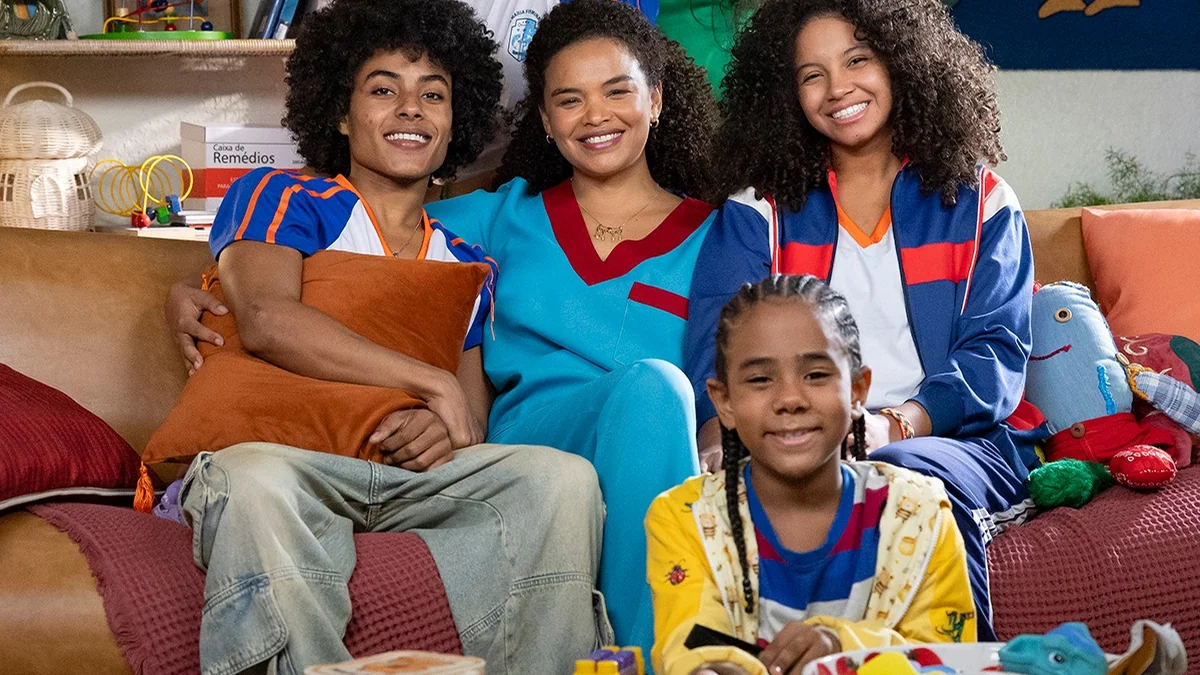
The seven o’clock telenovela is often remembered as a place for romance, humor and urban lightness. In Por Você, however, the main engine moves through a harsher image: four young people outside the home, without their mother, crossing the city while adults try to turn care into concrete responsibility. The series by Dino Cantelli and Juliana Peres does not abandon melodrama, but it shifts its center of gravity. The conflict is not only about who loves whom, but about who can protect, legally and emotionally, a family that has lost its base.
This week, Peixe, Glorinha, Ítalo and Samuca run away from the shelter after an assault on Peixe. The official gshow summary says Bela wins provisional custody of Juli’s children, but discovers the escape before she can stabilize the news. The same summary previews that the siblings try to return to their old house, find another resident there, have their backpacks stolen and end up taking shelter under an overpass. That is the confirmed fact. The interpretation is what it activates: the telenovela brings the seven o’clock slot closer to a conversation about childhood, housing, grief and belonging.
Melodrama Leaves the Living Room and Meets the Street
Brazilian television melodrama has always been strong when it turns social questions into intimate dilemmas. In Por Você, Juli’s death is not only the emotional starting point. It reorganizes the life of Bela, the doctor played by Sheron Menezzes, and moves the four children into a zone of uncertainty. Provisional custody works as a legal fact inside the fiction. But the escape shows that no administrative decision immediately resolves the fear of someone who has lost home, mother and routine.
Peixe, played by Cauê Campos, occupies that place of resistance. He is not merely the impulsive teenager of the plot. When he decides to escape with his siblings, he acts from a mix of pride, trauma and an attempt at control. The telenovela uses a recognizable structure: the young person who seems difficult is actually someone trying to protect what remains of his family.

Bela, Juli and Motherhood as a Pact
The story begins with a promise: after Juli’s death, Bela must care for her friend’s four children. gshow described the premise before the premiere, noting that the accident that kills Juli leaves Peixe, Glorinha, Ítalo and Samuca under Bela’s emotional responsibility. That information is central because motherhood here appears not as biological destiny, but as a pact of friendship, memory and choice.
That expands the series’ cultural force. Brazilian open television has a long tradition of stories about self-sacrificing mothers, recomposed families and children in transit. Por Você enters that lineage with a Black protagonist in a position of emotional and professional command. The young cast matters too: gshow presented Laura Luz, Fabrício Assis and Kadu Spinola as part of a new generation in the story, alongside Cauê Campos.

Youth as Language, Not Only as Audience
One of Por Você’s most interesting moves happened before its TV premiere. The production received a vertical mini-telenovela on Globo’s official social channels, with 20 episodes devoted to Juli and her four children before the tragedy. gshow reported that this microdrama began on August 10 on TV Globo’s networks and later reached Globoplay and Globopop.
This is not merely promotional detail. It changes how the audience enters the story. Instead of knowing Juli only as an absence, part of the audience encountered her routine, her children and her home in short episodes designed for vertical viewing. The main telenovela therefore receives an earlier layer of memory.
Representation Without Decoration
The presence of Sheron Menezzes, Lucy Ramos and Amaury Lorenzo in important positions also deserves careful reading. In an interview with F5, Amaury Lorenzo said he was living a special moment with Professor Lucas and highlighted the representational importance of occupying a prominent space as a Black actor. The report also noted that the character connects with the actor’s own path as a performing arts teacher.
The confirmed fact is the actor’s public statement about the role and representation. The interpretation is that Por Você relies on a rare set of images at the center of open TV: a Black woman doctor as protagonist, a Black single mother whose memory moves the story, a Black teacher in the protagonist’s emotional field and young Black or racialized characters at the core.
A Story About Belonging
In the end, this week of Por Você asks where a family begins after loss. Does it begin in the custody document? In the promise made to a dead friend? In the old house that no longer belongs to the children? Under the overpass that becomes shelter for a night? Or when Bela asks Peixe for another chance?
For those who follow culture in São Paulo, that conversation resonates beyond the screen. The city is also made of improvised bonds, broken routes, young people disputing space and families rebuilt between work, street and affection. Around Vila Madalena and Beco do Batman, where urban art turns walls into public memory, Por Você reminds us that every popular image carries a simple and difficult question: who has the right to be seen with complexity?
Continue In The Guide
Follow Becoartes for more readings on television, music, cinema and urban culture, with attention to what popular culture reveals about Brazil now.
Becoartes - Beco do Batman
99 Gonçalo Afonso Street, Vila Madalena, São Paulo
Sources and credits
- Globo — Reprodução editorial com crédito à fonte
- Globo — Reprodução editorial com crédito à fonte
- Divulgação/Globo — Reprodução editorial com crédito à fonte
- gshow - Resumo de Por Você de 31 de agosto a 05 de setembro
- gshow - Entenda a trama da novelinha vertical de Por Você
- gshow - Descubra as caras novas do elenco de Por Você
- F5/Folha - Amaury Lorenzo sobre o papel em Por Você