Cássio Gabus Mendes's exit from A Nobreza do Amor is not only a backstage move or a casting curiosity. When an actor with more than four decades of recognizable presence on Brazilian television says goodbye to a telenovela character, the gesture points to something larger: the way the telenovela still builds collective memory in the country.
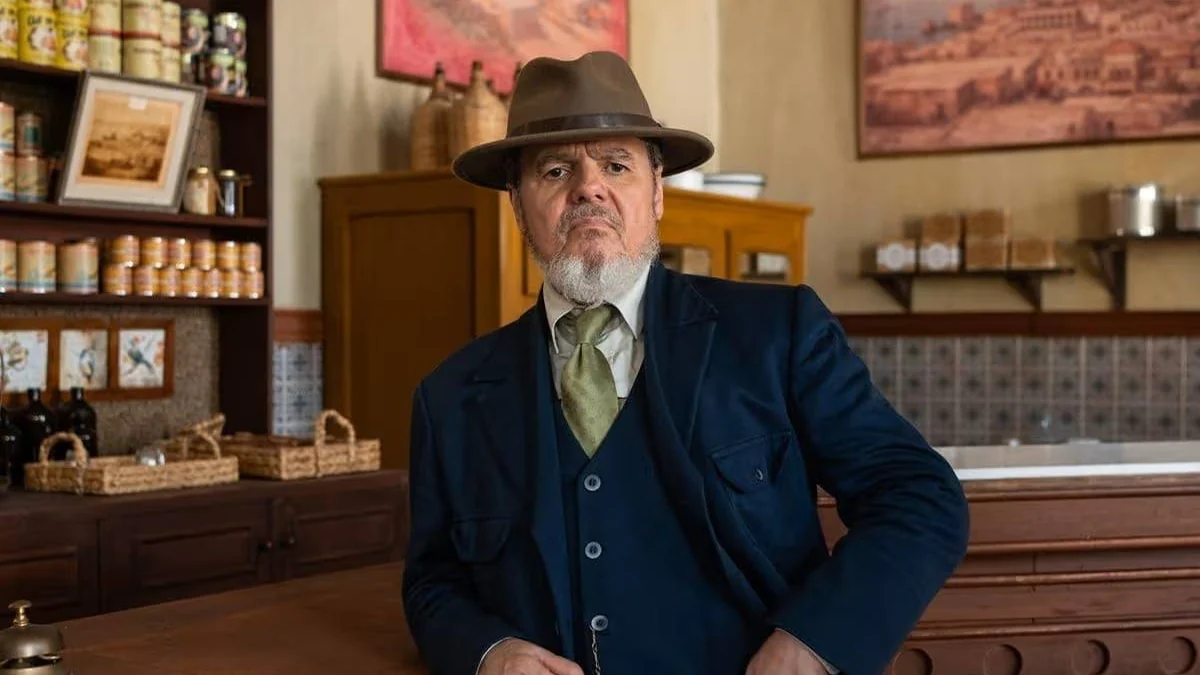
The confirmed fact is straightforward. According to VEJA, Cássio recorded his final scenes as Colonel Casemiro Bonafé on Wednesday, August 26, 2026. The publication reports that the character will die of natural causes and that his final appearance should happen at a mass, after his death, in a sequence expected for September. Band had reported that the actor's exit would unfold through the story and that Taís Araújo would join the plot as an African queen with a central role. Gshow, Globo's official channel, presents Casemiro as a colonel, an influential farmer in Barro Preto, Tonho's godfather and a possible ally of projects for progress in the town.
The interpretation begins there. Casemiro is a traditional dramatic figure, but not an irrelevant one: the local man of power who crosses a story about displacement, belonging, family disputes and imagined bridges between Brazil and Africa. In 2026, it remains culturally meaningful that an early evening telenovela places this kind of character inside a broader narrative about historical memory, social hierarchies and emotional reinvention.
The Confirmed Fact
The most recent available information indicates that Cássio Gabus Mendes ended his participation in the recording of A Nobreza do Amor on August 26, 2026. VEJA says the actor had already recorded Casemiro Bonafé's death, but still had to film the final sequence, in which the character appears dead during a mass with several characters from the story. The scene is expected to air in September.
Band had published on August 6 that Casemiro would leave the telenovela through the character's death, without the exit happening immediately. The same report pointed to the arrival of Taís Araújo as an African queen who would help the protagonist Alika, played by Duda Santos, in the confrontation with Jendal, played by Lázaro Ramos. The outlet also noted that the telenovela, written by Duca Rachid, Júlio Fischer and Elísio Lopes Jr., was expected to end in November 2026.
UOL's weekly summary for the episodes from August 28 to September 5 confirms that Casemiro remains central in the immediate dramatic arc: Tonho tells him that Mirinho hired a hitman, Casemiro falls ill and later says that whoever ordered the attack must be arrested. In other words, the character's farewell does not arrive as a side detail. It appears at the moment when the telenovela tensions family, justice, moral inheritance and patriarchal authority.

Why Cássio Matters Here
Cássio Gabus Mendes belongs to a lineage of actors whom Brazilian audiences recognize even before recalling every role. That matters because the telenovela is an art of sustained presence. Unlike cinema, where an appearance may be concentrated into two hours, daily television turns faces into company. The actor does not merely enter a story; he occupies weeks, months, domestic schedules, living-room conversations and fragments of memory.
That is why Casemiro's farewell has two layers. Inside the plot, it closes the arc of a colonel from Barro Preto, owner of the Santa Fé mill, caught in family interests and local tensions. In cultural terms, it is another chapter in the relationship between veteran actors and Brazil's popular imagination. A telenovela does not work only through plot twists. It depends on faces that carry trust, ambiguity and repertoire.
Cássio brings that repertoire. His presence allows Casemiro to be read as more than an old social type. The character becomes a key for observing how Brazilian television drama revisits figures of rural command, family, paternalism and transformation. Death by natural causes, if aired as reported, tends to produce less spectacle than consequence: the question is not only how Casemiro dies, but what his absence reorganizes.

The Six O'clock Telenovela as Period Territory
A Nobreza do Amor was presented by Gshow as a story divided between Batanga, a fictional kingdom on the west coast of Africa, and Barro Preto, in the interior of Rio Grande do Norte. The official synopsis highlights a story of exile, power struggle, refuge and romance, set in the 1920s. That design places the telenovela in a particular territory: the period melodrama that uses costume, scenery and emotion to talk about belonging.
The six o'clock slot often allows another kind of breath. Without abandoning conflict, secrets and villainy, it frequently works with memory, landscape and social formation. In A Nobreza do Amor, the bridge between Africa and Brazil's Northeast opens space for themes beyond the central romance: coloniality, displacement, symbolic nobility, work, land, local power and ancestry.
In this setting, Casemiro works as a structural piece. He is not the protagonist, but he sustains one of Barro Preto's social axes. Gshow describes the character as a major farmer, an influential figure and Tonho's godfather, with the possibility of supporting projects for progress in the town. The dramatic detail matters: a period telenovela does not speak of the past only through scenery. It chooses which social forces collide.
Casemiro's Arc and the Crisis of Authority
UOL's episode summary shows Casemiro facing an intimate rupture. Mirinho, his son, appears linked to an attempted attack on Tonho. Tonho, in turn, is Casemiro's godson and trusted man. The structure is classic: patriarchal power is forced to choose between blood, justice and reputation.
This type of conflict is old in television drama, but it still works because it touches a persistent Brazilian nerve. Powerful families, relations of favor, economic dependence and public morality remain recognizable material for viewers. The telenovela translates these structures into melodrama, but melodrama does not have to mean simplification. It can be a popular form for making social dilemmas visible.
Casemiro's future death, in this context, promises to shift the narrative balance. If the character was an authority figure able to contain or validate actions in Barro Preto, his exit opens space for rawer disputes. Graça, Mirinho, Tonho, Alika and the other characters begin to move on a less protected board. The absence of a patriarch, even a contradictory one, usually reveals what his presence had been managing.
Taís Araújo's Arrival Broadens the Reading
Band reported that Taís Araújo joins A Nobreza do Amor as an African queen with a central role, an ally of Alika against Jendal. At the time of the consulted report, the exact date of her first appearance had not yet been officially detailed. That care matters: the confirmed fact is the announced arrival; any reading of its impact depends on what airs.
Even so, Taís's arrival carries clear symbolic weight. In a telenovela that works with fictional African royalty, exile and disputes over legitimacy, casting an actress with such a strong trajectory in Brazilian television changes the temperature of the work. Taís is not only a cast reinforcement. She carries a history of protagonism, racial debate and public presence associated with shifts in Black representation on TV.
When her character joins Alika's journey, the telenovela gains another layer in the dispute over narrative. Who has the right to the throne? Who has the right to love? Who defines progress? Who tells the story of an African woman displaced to Brazil? These are melodrama questions, but they are also cultural questions. Casemiro's exit and the entrance of a new female authority seem, at minimum, to reposition the plot's center of gravity.
Between Fact and Interpretation
It is important to separate what is confirmed from what is interpretation. Reports confirm that Cássio Gabus Mendes is leaving A Nobreza do Amor, that Casemiro Bonafé's arc will end with the character's death and that the final sequence is expected for September. Globo's official material also confirms that Casemiro is a colonel, farmer, influential figure in Barro Preto and Tonho's godfather. UOL confirms that, in the episodes turning August into September, the character participates directly in the conflict involving Tonho and Mirinho.
The editorial interpretation is another layer: that this exit reveals how the Brazilian telenovela still organizes symbols of authority, memory and generational transition. There is no need to turn the subject into an automatic sentimental farewell. What is more interesting is to notice how a supporting character, played by a veteran actor, can illuminate the architecture of a work.
A Nobreza do Amor brings together romance, intrigue, historical imagination and Black representation on broadcast television. That does not erase contradictions or guarantee aesthetic success in every episode. But it explains why the movement around Casemiro matters beyond the spoiler. At stake is television's ability to make audiences discuss power, family and belonging within a popular language.
What This Farewell Says About Brazilian TV
Broadcast television no longer occupies the center of culture by itself, but it still knows how to produce everyday events. The daily telenovela remains a social technology: it distributes characters, lines, conflicts and images at a scale streaming rarely replicates with the same regularity. When an actor like Cássio Gabus Mendes leaves a story, the farewell speaks to that repertoire.
Casemiro Bonafé may be remembered as a fictional colonel, but his function is larger than the title. He organizes relations of work, family, debt, affection and authority in Barro Preto. His announced death forces the plot to answer who inherits the house, who inherits the guilt and who inherits the courage to break with the old logic.
For São Paulo, a city that consumes culture across multiple screens while preserving the habit of discussing telenovelas on transport, in bars and online, this kind of story shows that popular culture remains serious material. At Beco do Batman, where public image changes with every painted wall, Becoartes looks at the telenovela for the same reason: because every city needs to understand which stories keep painting the collective imagination.
Read With Cultural Attention
Follow the telenovela beyond the recap: observe how characters, actors and images dispute memory, power and representation in Brazilian culture.
Becoartes - Beco do Batman
99 Gonçalo Afonso Street, Vila Madalena, São Paulo
Sources and credits
- Estevam Avellar/TV Globo — Reprodução editorial com crédito à fonte
- TV Globo — Reprodução editorial com crédito à fonte
- TV Globo — Reprodução editorial com crédito à fonte
- Band - Com saída de Cassio Gabus Mendes, A Nobreza do Amor ganha reforço de peso
- UOL Splash - Resumo de A Nobreza do Amor de 28/8 a 5/9