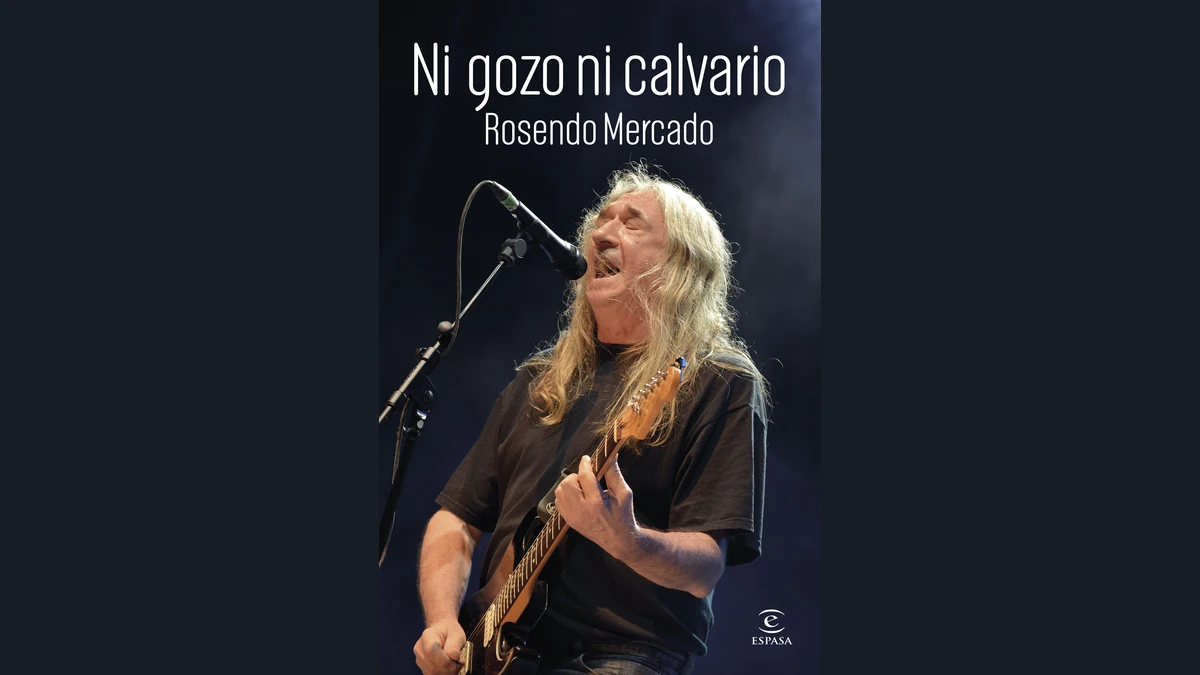
A record might need three minutes to explain why a guitarist is remembered. To explain how he got on stage in the first place can take a book. On Wednesday, November 25, Espasa publishes *Ni gozo ni calvario*, the memoir of Spanish guitarist, singer and songwriter Rosendo Mercado. Its title resists two easy stories about a musician’s life: uninterrupted bliss on the one hand, an endless ordeal on the other. Between them lies a more interesting subject: what it took to keep making music for more than four decades.
For the listener who knows the chorus of *Maneras de vivir* but could not place Carabanchel on a map, the book offers a way into that story. For someone who watched Spanish rock change firsthand, the attraction is different: the chance to find out which parts of a familiar career the musician himself would choose to tell. Neither reader has to approach it as a substitute for the records. In fact, this is a good occasion to put a few on.
Before there was a band, there was a neighborhood
Carabanchel matters for a more practical reason than its use as shorthand for Madrid street rock. It is the setting of the childhood Mercado revisits. Espasa describes a story that takes in his first guitar and early paid engagements before arriving at the bands and the public recognition. Finding an instrument and finding a place to play it are two different adventures. A résumé tends to begin with the group that took off; a memoir can start when there was no group at all.
Madrid eventually recognized the guitarist with the city’s Gold Medal in 2017. The city cited both his contribution to Spanish rock and his connection to Madrid. Set that honor alongside the boy growing up in Carabanchel and the gap between the two becomes the interesting part. A playlist of the biggest songs cannot tell us very much about the working days between learning an instrument and being honored by the city where you learned it.
A photograph with an address: Getxo, 1981
One night in that working life can be dated without relying on anybody’s recollection. On August 28, 1981, Leño played on the grounds of Aixerrota in Getxo at an anti-nuclear gathering. Fernando Catalina Landa photographed the band there. The photograph survives in a public archive and can be consulted independently of the book. It does something valuable in its own right: it locates a group now familiar from record sleeves in a particular place, playing for a particular occasion.
Leño released its self-titled first album in 1979. To hear the distance between a studio performance and a song shared with an audience, seek out the band’s live record. The musician’s official biography notes a detail that streaming playlists can obscure: *Maneras de vivir* had been recorded in the studio for a single before appearing on the live album. Try the two recordings in succession. The composition carries across; what changes is the conversation between the voice, the instruments and the people on the receiving end.
A solo debut that had to wait
On a shelf, or on a phone, moving from Leño’s *¡Corre, corre!* to *Loco por incordiar* takes a moment. In the guitarist’s working life it took rather longer. According to his official biography, problems with his former record company delayed the release of the solo debut until 1985. RCA put it out, with Carlos Narea producing. That detail shifts the question from when someone decides to use his own name to when he is actually able to put out a record under it.
There is another useful listening point in 1998, when Mercado adopted a three-piece format: guitar, bass and drums, without keyboards. Listen to a passage once for the bass, then again for the spaces the guitar leaves. It is an easier way to hear the implications of a change in personnel than trying to remember a list of releases. What a musician chooses not to play can be as revealing as the sound that fills the room.
What the Spanish edition offers
The Spanish paperback has flaps, measures 15 by 23 centimeters and carries ISBN 978-84-670-8297-5. Espasa also lists a digital EPUB edition. For the print book, the publisher singles out the sections of color photographs, including several previously unpublished images. This is a first-person account with a visual archive, not a new album or an announcement that Rosendo is returning to the stage.
For anyone coming fresh to the music, start with the first Leño record, follow it with the live *Maneras de vivir*, then move to *Loco por incordiar*. From there, the official discography offers later live recordings from Barcelona and Madrid’s Las Ventas. Rather than hunting in the book for the meaning of every song, try turning the exercise around: find out first what made it onto the record, then read about the parts of a musician’s life the microphone did not pick up.
Image credits. Context photographs resized, framed with margins and converted to WebP without cropping. Espasa / Planeta de Libros (Capa de divulgação disponibilizada na sala de imprensa da editora para cobertura do livro; não é licença aberta.); Zarateman (CC0 1.0).
Sources for this story
Original documents are linked in the article.
Becoartes - Beco do Batman
99 Gonçalo Afonso Street, Vila Madalena, São Paulo
Sources and credits
- Espasa / Planeta de Libros — Capa de divulgação disponibilizada na sala de imprensa da editora para cobertura do livro; não é licença aberta.
- Zarateman — CC0 1.0
- Espasa: Ni gozo ni calvario
- Rosendo: biografía oficial
- Rosendo: discografía oficial
- Ayuntamiento de Madrid: Medallas de San Isidro 2017
- Fernando Catalina Landa: Leño, Getxo, 1981