There are two addresses to put on the map for the opening of the Pinacoteca’s new exhibition on Saturday, November 28. One is a museum; the other is where artist and filmmaker Jane Jin Kaisen will meet the public at 11 a.m. for a procession through Bom Retiro. The walk ends at Pina Contemporânea, where the second part of Via Satellite brings the work of video artist Nam June Paik into conversation with four artists working today. You can head straight to the gallery, but the walk offers a way into a show about connecting distant places without so much as switching on a screen.
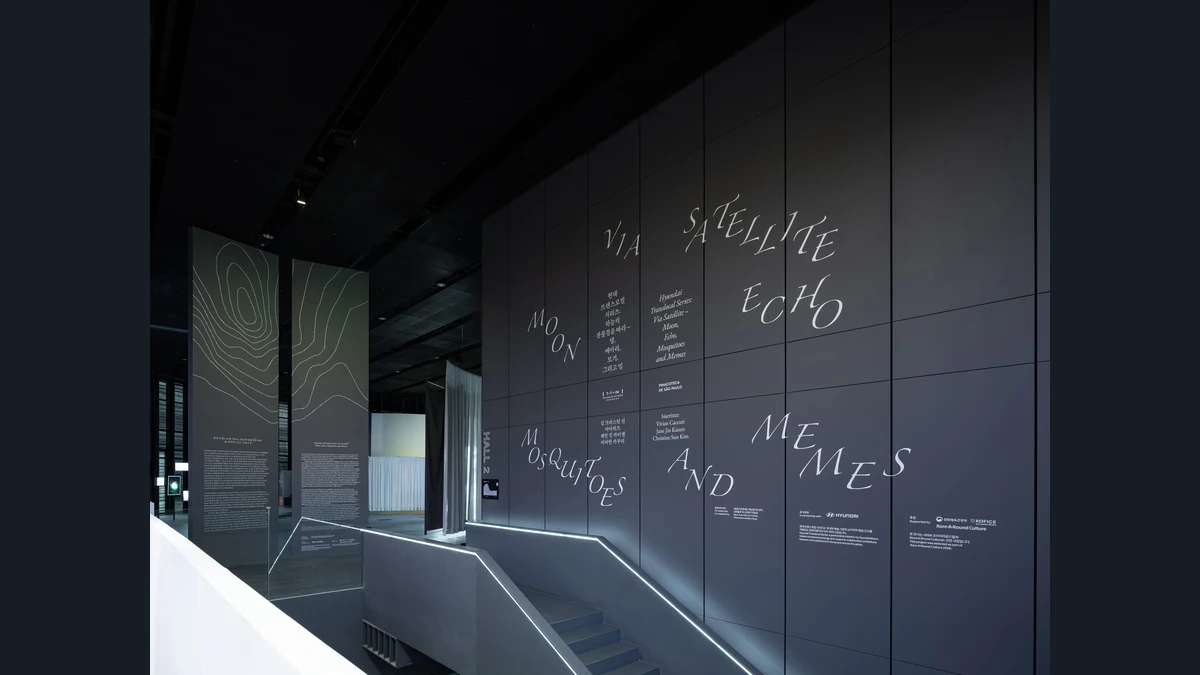
The first stop is on Rua Três Rios
Knots and Folds II starts at the Complexo Cultural Oswald de Andrade, at Rua Três Rios, 363. Participation is open. Kaisen suggests wearing white; the museum does not list it as a requirement. The material at the center of the gathering is sochang, a traditional Korean cotton fabric used in everyday life and in rites of passage. The group will make its way to Pina Contemporânea, at Avenida Tiradentes, 273. For anyone coming specifically for the performance, that second address is the destination, not the meeting point.
Kaisen developed the idea after a research visit to São Paulo brought her to Bom Retiro and its Korean immigrant community. Here, the relationship between São Paulo and Korea is a matter of local history rather than a line drawn between two museums on a map. Joining the procession means sharing a route with other people for a morning. The exhibition will remain open until April 18, 2027, but this part of the opening program has a particular time and place: it is not a walk visitors should expect to find every weekend.
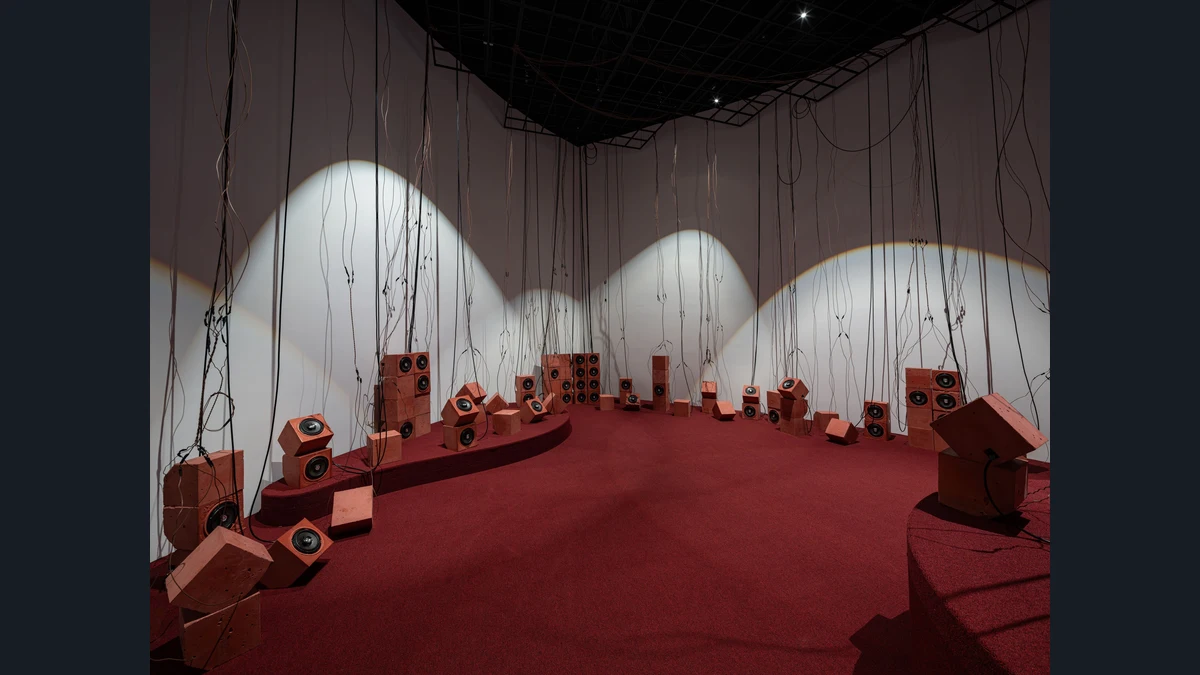
Two moons, and only one telescope
A pair of works in the basement Grande Galeria offers a good starting point for visitors. In Moon is the Oldest TV, Paik produced the phases of the moon by altering the internal circuitry of television sets. What looks like an astronomical picture did not arrive via an observatory or TV station. The receiver itself made it. Arranged in a semicircle, the screens let the eye do in a matter of seconds what an observer of the night sky would need many days to see.
Kaisen takes almost the opposite approach in Old Moon – New Moon. She used a telescope in Copenhagen to film the moon in one continuous twelve-minute shot. Rather than dividing a cycle into a series of screens, the artist invites the viewer to stay with a single view. The film is part of the program in both São Paulo and Yongin, South Korea. That does not make it a live telescope feed. What audiences share across the distance is a recording and the time it takes to watch it, not the same local sky.
Where do you sit to watch a garden?
TV Garden rearranges a familiar domestic ritual. Instead of a screen facing a sofa, monitors sit among living plants and play Paik’s 1973 video Global Groove. There is still a program to watch, but the leaves and the other screens are not peripheral details that can be tidied out of the picture. Try following the moving image first, then stepping back until it is just one lit surface among many. You need not have caught the first frame of the video to notice how moving your body changes the composition.
The museum’s first Paik presentation is still on view in the same building. The Galeria Praça section, open since October, considers music and sound through Paik, Charlotte Moorman and Vivian Caccuri. The Grande Galeria section opening on Saturday adds questions of participation, communication and language. It is an addition, not a changeover. Someone who saw the earlier presentation has a reason to return; a first-time visitor can move between the two instead of trying to fit both arguments into one room.
A lullaby shared by two people
In One Week of Lullabies for Roux, Christine Sun Kim started from a problem that was at once musical and personal. A Deaf artist and a new mother, Kim wanted a lullaby that she and her daughter could experience together. She invited seven friends to compose pieces using low frequencies. What might have been an exercise in choosing the right tune became a different question: how can the same work reach two bodies, without assuming they hear in exactly the same way?
Brazilian artist biarritzzz makes another case for looking beyond writing or speech. She worked with Mozambican dancer and choreographer Tsumbe Mussundza on Three Origins of the Word Samba. The history of a word is not confined to what someone writes down about it; here, the movements of a dancer are part of the inquiry. Set beside the garden and the two moons, those works suggest a useful approach to the show. Ask not only what is being broadcast, but who can receive it, and what that person does to make sense of it.
Visiting the São Paulo exhibition
Pina Contemporânea is open Wednesday through Monday from 10 a.m. to 6 p.m., with last admission at 5 p.m. Admission is free on Saturdays, including opening day, and on the second Sunday of each month. The show is suitable for all ages. If you want to see Kaisen’s unbroken shot in full, budget twelve minutes for that work alone. And for the opening procession, remember that the day begins at 11 a.m. at the Oswald de Andrade cultural center, not at the museum doors.
Image credits. Images resized, framed with margins and converted to WebP without cropping. Cheolki Hong / Hyundai Global Newsroom (Hyundai Global Newsroom media kit — editorial publication online); Cheolki Hong / Hyundai Global Newsroom (Hyundai Global Newsroom media kit — editorial publication online).
Sources for this story
Original documents are linked in the article.
Becoartes - Beco do Batman
99 Gonçalo Afonso Street, Vila Madalena, São Paulo