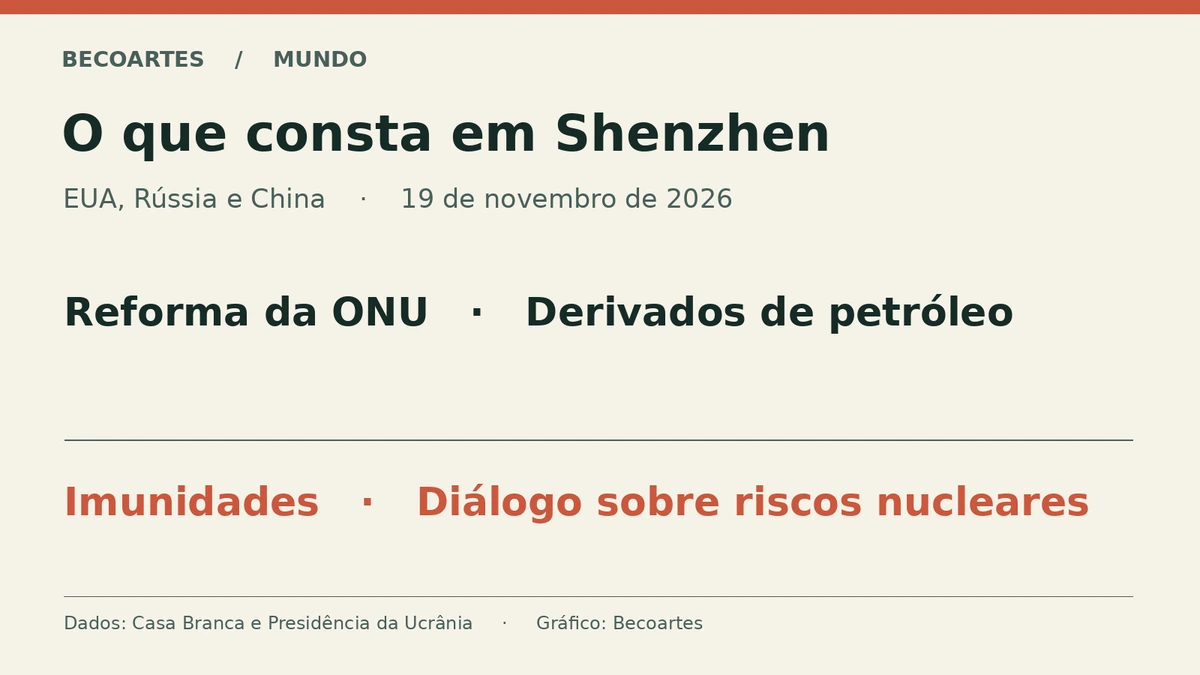
The declaration the White House published on November 19, 2026, contains four points. It followed a meeting in Shenzhen, China, between Donald Trump, Vladimir Putin and Xi Jinping. Their governments addressed United Nations reform, supplies of refined petroleum products, immunities for officials and talks on reducing nuclear risks. Ukraine does not appear in any of the four points. The document announces no ceasefire and gives no schedule for negotiations on the war.
The nuclear section announces talks, not reductions
The United States, Russia and China reaffirmed their position that no one can win a nuclear war and that one should never be fought. The next step they identified was dialogue on reducing risks and preventing the proliferation of nuclear weapons. The text does not name a date or venue, or identify participants other than the three countries.
The distinction matters because a pledge to talk is not a disarmament agreement. The statement does not cap arsenals, specify reductions or establish a way to verify compliance with an obligation. If a later meeting were scheduled, it would be possible to check whether the dialogue began. That would not on its own demonstrate that the countries had already agreed on measures.
The other points concern the UN, energy and international courts
All three governments are permanent members of the UN Security Council. The text records their commitment to work on reforming the United Nations so it can respond to international challenges. It does not spell out a change to the composition of the council, the way its votes are counted or the operation of a specific UN body.
On energy, the leaders say they plan to increase production and supplies of refined petroleum products. They do not supply volumes, timetables or domestic implementing measures. The statement alone therefore does not allow readers to estimate an effect on fuel prices. On courts, the text stresses the immunities of state officials and states the three governments’ view that international courts should not overstep their jurisdiction. That is a political position, not a court ruling or a change to a court’s rules.
A separate meeting in Berlin addressed Ukraine
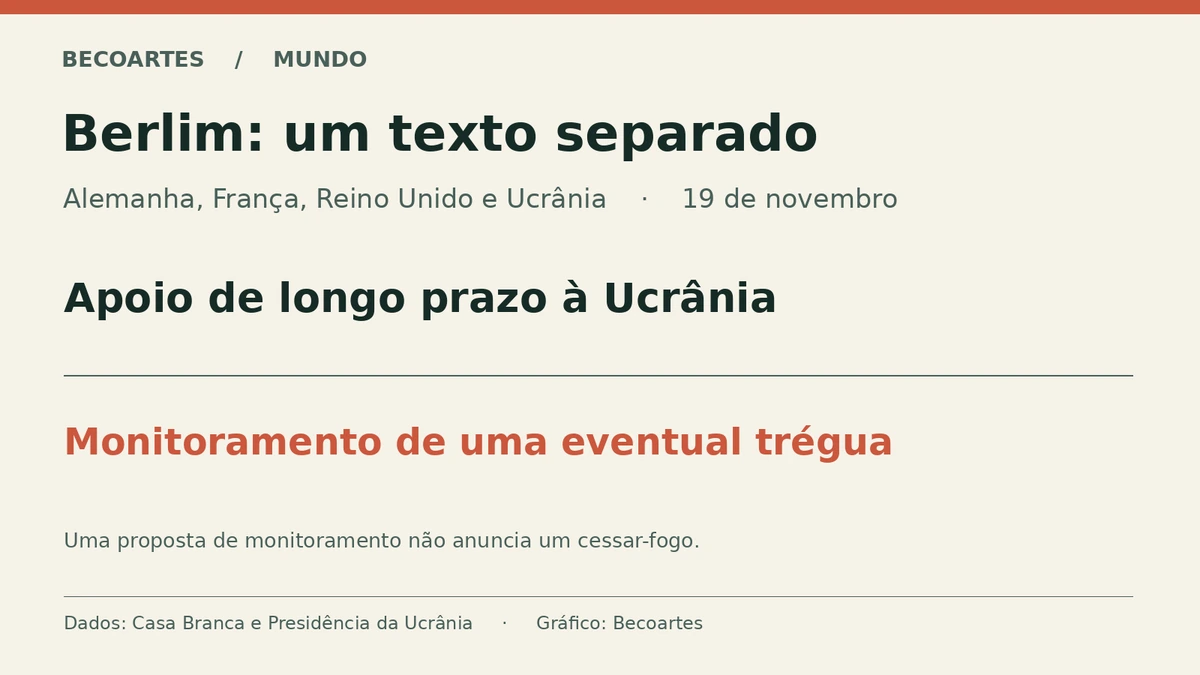
There was also a meeting in Berlin on November 19 with the Coalition of the Willing, Ukraine and the United States. The statement released by the Ukrainian presidency names Germany, France, the United Kingdom and Ukraine as its four authors. US participation in the meeting does not make it a named author of that particular text.
The Berlin document focuses on support and security guarantees for Ukraine. Among the possibilities are continuing assistance in areas such as funding, training and military support, and participation in a potential US-led ceasefire monitoring mechanism. That is an outline of what allies might do if there were a ceasefire. It is not evidence that Ukraine and Russia have already agreed to stop fighting.
Monitoring a ceasefire is not the same as reaching one
A ceasefire and a monitoring mechanism do different jobs. One establishes a halt to fighting under defined conditions. The other enables observers to check whether the commitment is being kept. The second can be discussed before the first has been agreed. Berlin addressed the issue in that conditional sense.
To confirm a later ceasefire announcement, the important details would be who accepted the commitment, what territory or activity it covers, and when it takes effect. Looking for those details makes it easier to distinguish an agreement from a plan proposed by governments that would support it.
APEC published a different document as well
Shenzhen hosted the Asia-Pacific Economic Cooperation forum, whose declaration records an agenda for 21 economies on trade, investment, connectivity, innovation and growth. It is separate from the statement issued by the US, Russia and China, even though the same city is associated with both documents in the same week.
A useful way to follow developments is to start with who put out each text. The White House published the trilateral statement. The Ukrainian presidency published the declaration of four governments after the Berlin meeting. APEC issued its own multilateral declaration. None of the three should be used to attribute to one group commitments announced by another.
Compare the statements
Read the Shenzhen and Berlin documents separately in the official sources.
Becoartes - Beco do Batman
99 Gonçalo Afonso Street, Vila Madalena, São Paulo
Sources and credits
- Gráfico original: Redação Becoartes. Dados: Casa Branca e Presidência da Ucrânia. — Gráfico original produzido para publicação pelo Becoartes; não reproduz arte de terceiros.
- Gráfico original: Redação Becoartes. Dados: Casa Branca e Presidência da Ucrânia. — Gráfico original produzido para publicação pelo Becoartes; não reproduz arte de terceiros.
- Ministério das Relações Exteriores da China — encontro trilateral
- APEC — declaração econômica