The Museum of Sacred Art of São Paulo is not simply a collection housed at an old address. It occupies the left wing of the Monastery of Light, while other parts of the complex retain a religious use. To understand what makes it distinctive, consider three dimensions at once: the works on display, the colonial rammed-earth construction and the boundaries created by enclosure. The building is therefore more than a backdrop: it preserves techniques, spatial choices and continuities of use.
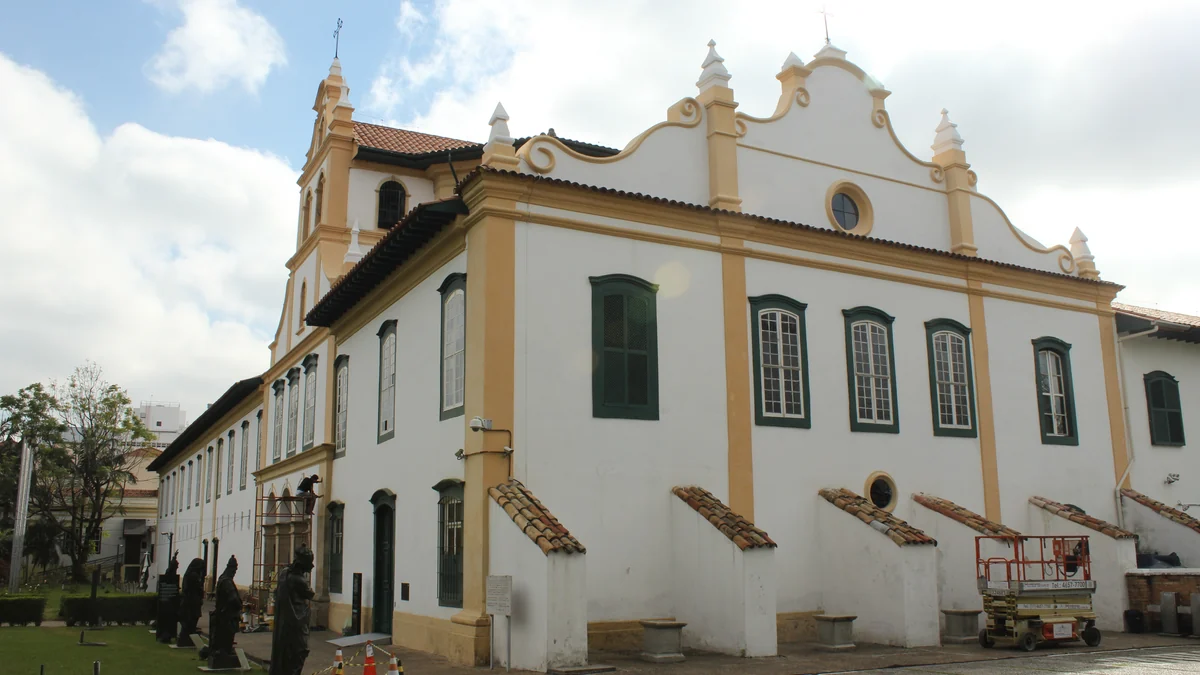
Before the sculptures, observe the building
The history presented by the museum begins in Campos do Guaré, now the Luz district. A chapel dedicated to Our Lady of Light stood there in 1774, with origins dating back to 1603. That year, the surrounding houses were occupied by the Retreat of Our Lady of the Conception of Divine Providence.
Because the chapel was at risk of collapse and the dwellings were unsuitable, Frei Galvão designed a new building. The religious women moved into it on 25 March 1788, although the church still required another 14 years of work. The design included two towers that were not built after Frei Galvão died in 1822. This chronology, detailed in the official history of the Monastery of Light, helps us read the façade as the outcome of a process, rather than a composition completed all at once.
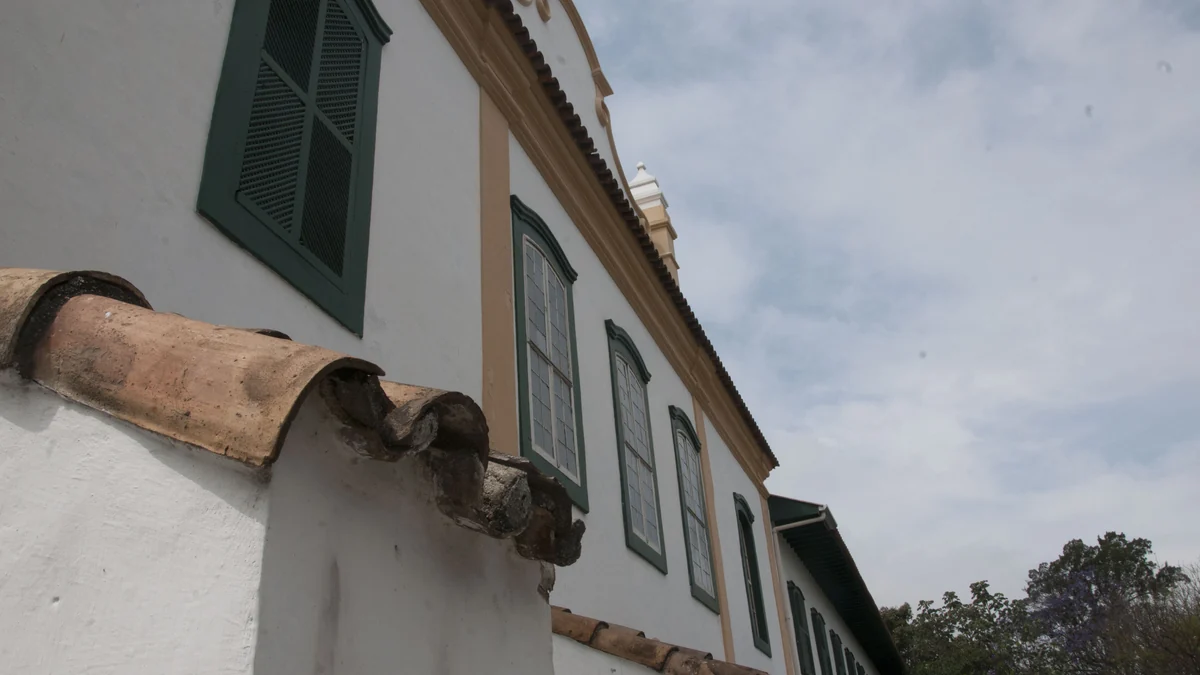
Rammed earth turns the wall into a document
The construction technique becomes tangible in a room maintained by the museum: visitors can see original rammed-earth walls measuring 1.05 metres thick. According to the institutional account marking the Museum of Sacred Art’s 50th anniversary, the monastery preserves eighteenth-century colonial elements, materials and structure while remaining in use.
This is a good place to slow down. Instead of looking only at ornament, notice thickness, openings, circulation and transitions between rooms. The exposed wall makes it possible to understand rammed earth not as an abstract term in a textbook, but as a load-bearing material. Cultural value lies both in what is hung or placed before it and in the construction itself, which has crossed different functions and periods.
How to look at the Baroque without separating form and devotion
The collection comprises thousands of objects drawn from the Metropolitan Curia’s collection and works belonging to the São Paulo state government. The institution highlights sacred and Baroque sculptures, as well as altars, oratories, silverware, religious metalwork, jewellery, furniture, paintings and photographs, mostly produced between the sixteenth and twentieth centuries. Because display space is limited, the museum says that it shows between 14% and 20% of the collection on a rotating basis.
This calls for caution: an object mentioned in the institutional history will not necessarily be on display when you visit. Check the current programme on the official website. When viewing the sculptures that are accessible, compare gestures, folds, expressions, scale and their relationship to altars or oratories. This approach connects artistic technique and devotional function without reducing the Baroque to decoration.
There is also a specific international cultural connection: the museum says its collection of sanctuary lamps is second in size only to that of the Vatican Museums, and it houses the Neapolitan Nativity Scene, comprising 1,620 eighteenth-century pieces. These references place the São Paulo collection within a broader history of sacred art, although each ensemble should be understood in its own context.
Enclosure is not a closed museum gallery
The complex remains home to nuns of the Order of the Conceptionists of the Immaculate Conception. The convent grounds, described by the institution as the last surviving example of their kind in urban São Paulo, are reserved for the religious community and are not open to the public.
This distinction prevents a mistaken expectation: museum, church, monastery and convent grounds belong to the same historical reality, but they do not share the same access rules. The restriction is not an attraction that happens to be unavailable; it corresponds to the continued presence of an enclosed community. Observing the visible boundaries — without assuming the entire complex belongs to the visitor route — is also a way of understanding living heritage.
Frei Galvão between design, labour and religious memory
Frei Galvão’s work connects these layers. According to the museum, he handled bureaucratic matters, planned the works, sought funds and followed the construction. The site also retains a devotional dimension linked to his memory: he was canonised in 2007 as Brazil’s first saint. The account of the so-called pills and their distribution by the Conceptionist Sisters belongs to the realm of faith, presented by the museum itself as intangible heritage, and should not be mistaken for medical guidance.
This continuity explains why the building requires a different reading from that applied to a museum venue without religious use. Construction history, worship, retreat and exhibition are not merely layered here: they continue to negotiate space in the present.
How to organise your observation and arrival
A productive sequence is to begin with the façade, continue to the material signs of construction, observe the objects available and finally recognise the boundaries of enclosure. In this way, what cannot be visited also gains context, without promises of access.
The museum lists its address as Avenida Tiradentes, 676, Luz, São Paulo, with entry through the car park at Rua Jorge Miranda, 43; Tiradentes metro station is the stated landmark. Opening hours, tickets, exhibitions and admission conditions may change, so always consult the official Monastery of Light page before setting out.
Continue exploring art in São Paulo
After discovering this relationship between artworks, architecture and the city, consider Becoartes for another moment in your cultural itinerary: Rua Gonçalo Afonso, 99, Vila Madalena.
Becoartes - Beco do Batman
99 Gonçalo Afonso Street, Vila Madalena, São Paulo
Sources and credits
- Marcos Ruocco Battistelli — CC BY-SA 4.0
- Carolina de Barros — CC BY-SA 4.0
- Museu de Arte Sacra — história, arquitetura e informações atuais de visitação do Mosteiro da Luz
- Museu de Arte Sacra — acervo e história institucional nos 50 anos do museu
- Museu de Arte Sacra — chácara conventual e restrição de acesso ao espaço das Irmãs Concepcionistas
- Museu de Arte Sacra — Frei Galvão, o projeto do mosteiro e o patrimônio imaterial da fé
- IPHAN — relação oficial de bens tombados em São Paulo, incluindo o Mosteiro, a igreja e o quintal