ACAB stands for “All Cops Are Bastards”—or, in a historical British variant, “All Coppers Are Bastards.” 1312 conveys the same phrase numerically: A, C, A, and B occupy positions 1, 3, 1, and 2 in the alphabet.
That direct explanation does not tell the whole story. The expression passed through British working-class and prison environments, punk and skinhead culture, football supporters, graffiti, and political movements. No known document securely establishes a single author, year, or inaugural episode.
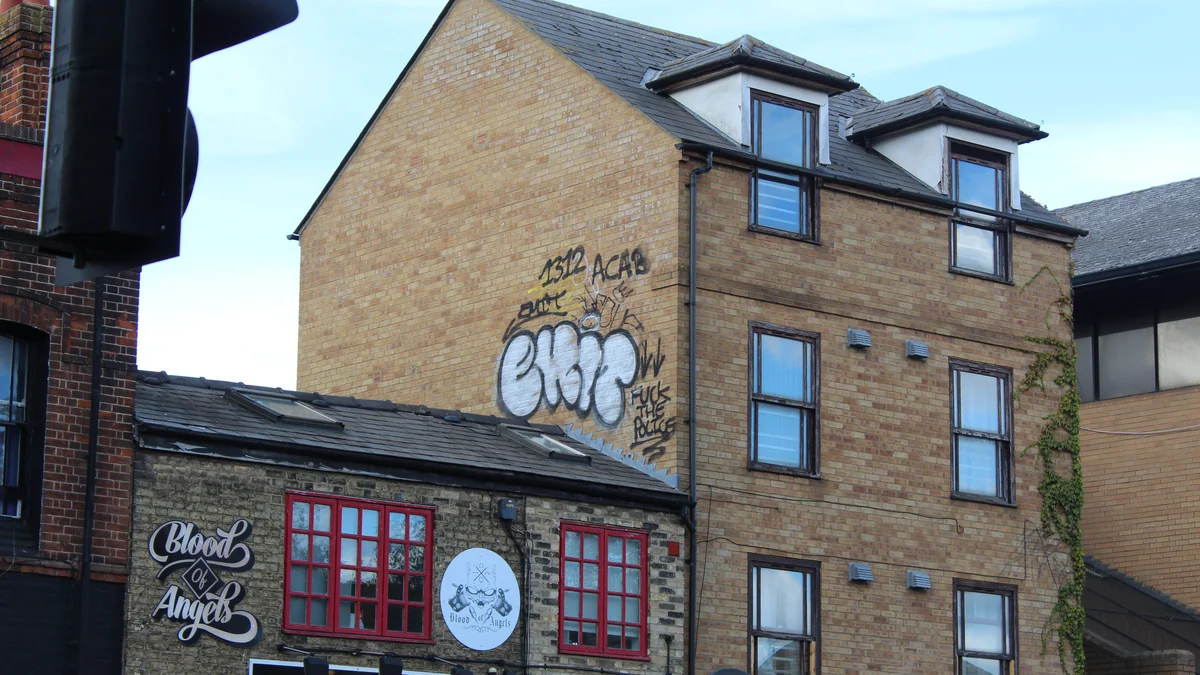
Why ACAB and 1312 are equivalent
The code 1312 simply replaces each letter with its position in the alphabet. The equivalence is recorded both in an explainer published by the French newspaper DNA and in an interview with scholar Gwenola Ricordeau.
This coding allows the reference to appear without the full English phrase on clothing, stickers, tattoos, or urban inscriptions. It does not, however, create a separate meaning: understanding 1312 requires knowing the acronym behind the numbers.

The origin cannot be reduced to one date
The most frequently repeated accounts place the phrase in working-class England during the first half of the 20th century. A historical investigation by VICE reports that lexicographer Eric Partridge said he had heard a short song containing “all coppers are bastards” in the 1920s. The phrase is also sung in the documentary *We Are the Lambeth Boys*, filmed in 1958.
The claim that striking workers created the acronym in the 1940s is described by that same investigation as possibly apocryphal. GQ likewise calls the precise origin unknown, while placing its broad emergence in England during the first half of the last century.
The distinction matters: there are records of the phrase, indications of its use among workers and people associated with criminal milieus, and accounts concerning the acronym, but together they do not amount to a birth certificate. Saying that ACAB definitively “began” in a strike, prison, or song turns a recurring hypothesis into certainty.
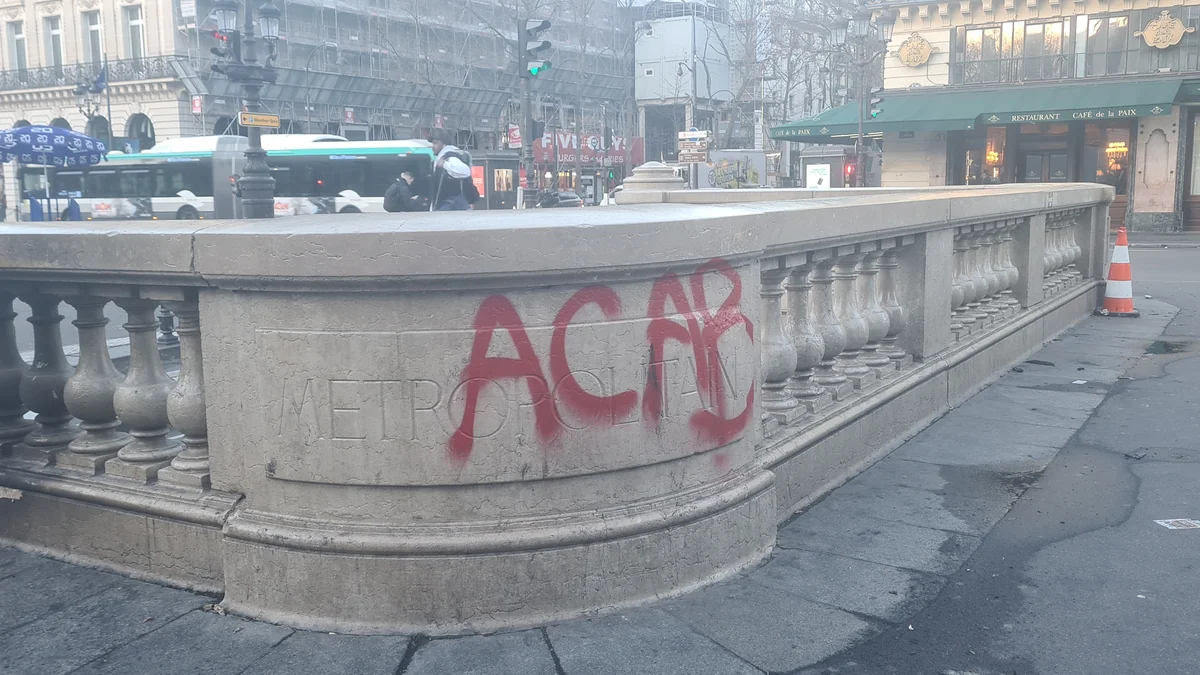
Prisons, punk, and skinhead culture widened its circulation
The expression gained traction in the British prison system, where it was written on walls and bodies. According to VICE, its international expansion was aided by late-1970s punk, especially the working-class Oi! strand. The German band Slime released a song titled “A.C.A.B.” in 1981; the following year, London group The 4-Skins released another song with the same title.
This path helps explain why the acronym has never belonged to a single political current. GQ notes that it circulated in anarchist and anti-authoritarian environments as well as among skinhead segments with different political orientations. Its isolated appearance therefore does not automatically identify the precise ideology of the person who wrote it.
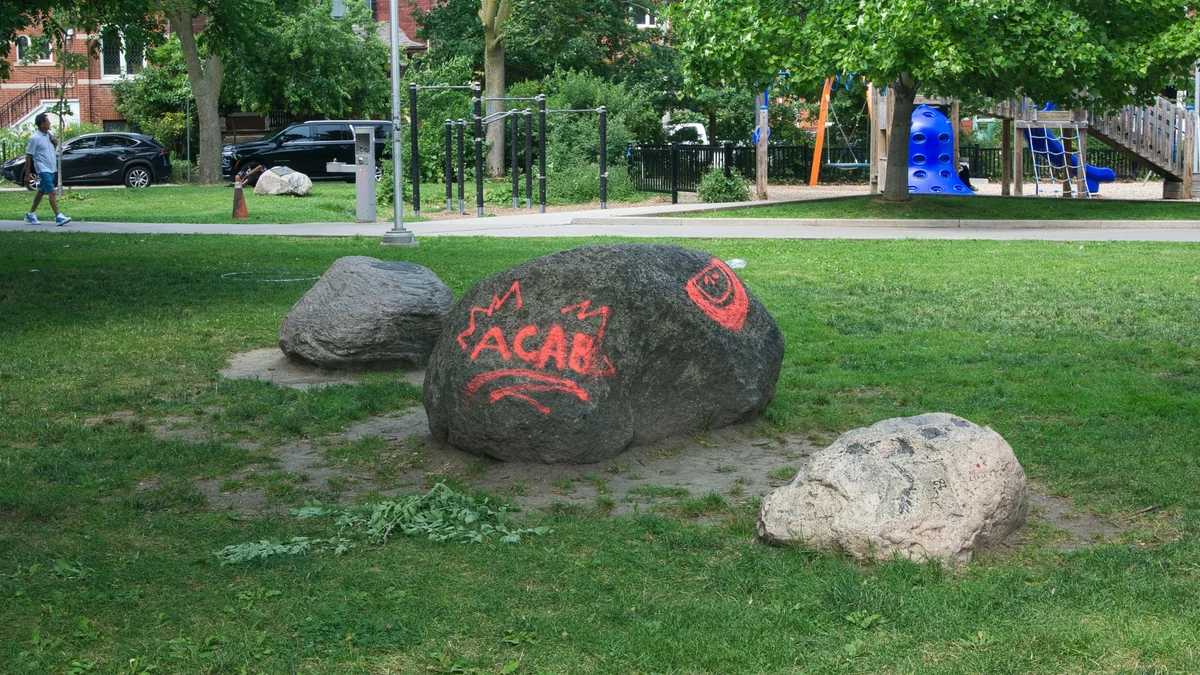
From stadiums to transnational protests
The connection between the skinhead scene and parts of terrace culture helped ACAB reach football supporters in other countries. DNA places its adoption by Italian ultra groups in the early 1990s, before broader diffusion across Europe and beyond.
Graffiti, music, clothing, and social media made the code recognizable outside those settings. Today, it may serve as a general provocation against authority, a denunciation of police violence, or a critique of the police as an institution. Those meanings overlap, but they are not identical.
The acronym has also been appropriated in conflicting ways. GQ notes that it has appeared among both racist and anti-racist groups, making visual, political, and territorial context essential. A photograph of four letters, without further information, does not establish affiliation with a particular movement.
Why the slogan appears in French protest culture
In France, visual inscriptions form part of a broader repertoire of dissent alongside songs, rhythms, banners, and chants. A study published by OpenEdition shows how French social movements reuse and transform sonic and visual materials, including when protest shifts from streets to windows, balconies, and social media.
Within that repertoire, ACAB offers a short, transnational, easily reproduced formula. The 1312 version condenses the reference even further. This helps explain its ability to cross languages, but it does not mean that everyone using it supports the same political program.
Context determines the reading—and the legal limits
Translating the phrase is straightforward; interpreting a particular occurrence requires looking at where it appears, who uses it, and what event it addresses. Nor should every display be assumed automatically lawful or unlawful. Legal assessments can vary by country, medium, target, context, and any damage to property.
The safest way to read ACAB or 1312 is to separate three levels: literal meaning, the documented history of circulation, and the specific intention behind each use. The first is clear; the second can be reconstructed only in part; the third depends on context.
Discover Becoartes
Art and urban culture at Rua Gonçalo Afonso, 99, Vila Madalena. Learn more on the [Becoartes website](https://becoartes.com/).
Becoartes - Beco do Batman
99 Gonçalo Afonso Street, Vila Madalena, São Paulo
Sources and credits
- LoLIamHappy — CC0
- AVDLCZ — CC0
- Guallendra — CC BY-SA 4.0
- Chicken4War — CC BY-SA 4.0
- OpenEdition — expressões sonoras e visuais dos movimentos sociais franceses
- Dernières Nouvelles d’Alsace — explicação publicada após mobilização recente
- VICE — investigação histórica sobre a origem e difusão do slogan
- GQ — história de ACAB, 1312 e suas apropriações subculturais
- Lux Éditeur — explicação de 1312 em entrevista com Gwenola Ricordeau
- La Gazette Locale — explicação francesa de ACAB e 1312