The story of the mummified cats of Beni Hassan can seem to end in 1890, when a shipment of animal remains from Egypt reached Liverpool and was sold for use as fertiliser. A study by Wim Van Neer, Bea De Cupere and Claudio Ottoni follows a different trail. The researchers examined 131 skulls at Vienna’s Natural History Museum and read nineteenth-century letters to understand how that collection was assembled. Their paper, already available ahead of the December 2026 issue of the Journal of Archaeological Science, reports an examination of the Vienna collection. It does not announce a new shipment or a rediscovery of the Liverpool auction lot.
Liverpool and Vienna followed different paths
The two sets of remains have a geographic connection. Beni Hassan is the region named both in accounts of the material shipped to England and in records about the skulls studied in Austria. To reconstruct the Vienna collection’s history, however, the authors used correspondence about acquisitions in the 1880s. That evidence does not allow us to attach the story of a shipment that arrived in Liverpool years later to the objects in Vienna. Provenance includes the path from a site to a cabinet, not just a name on a map.
An account published in 1890 and preserved by the US National Library of Medicine put the English shipment at about 180,000 animals. The figure indicates what contemporaries believed about the size of the shipment. It is not a count made today, it does not describe the Vienna specimens, and it does not establish that every animal arrived intact. The 131 objects in Vienna are preserved skulls that were actually examined, not an estimate of the entire Egyptian site.
How researchers distinguish one cat from another
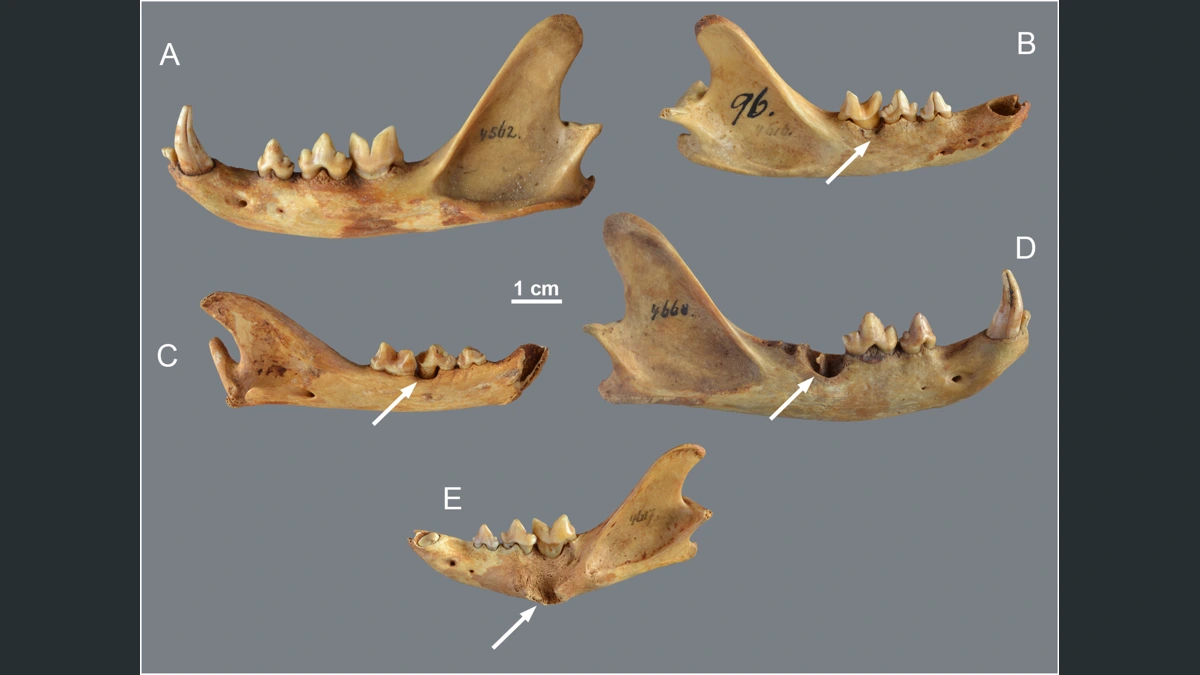
The researchers compared the shapes of bones and measured skulls and teeth. They identified a small number of jungle cats, Felis chaus. The size variation among the other specimens led them to consider the possibility that the collection contains African wildcats, and perhaps hybrids, as well as domestic cats. That does not make every intermediate-sized skull an identified hybrid. A measurement narrows the range of possibilities but cannot establish a clear identification for every specimen on its own.
What the bones recorded
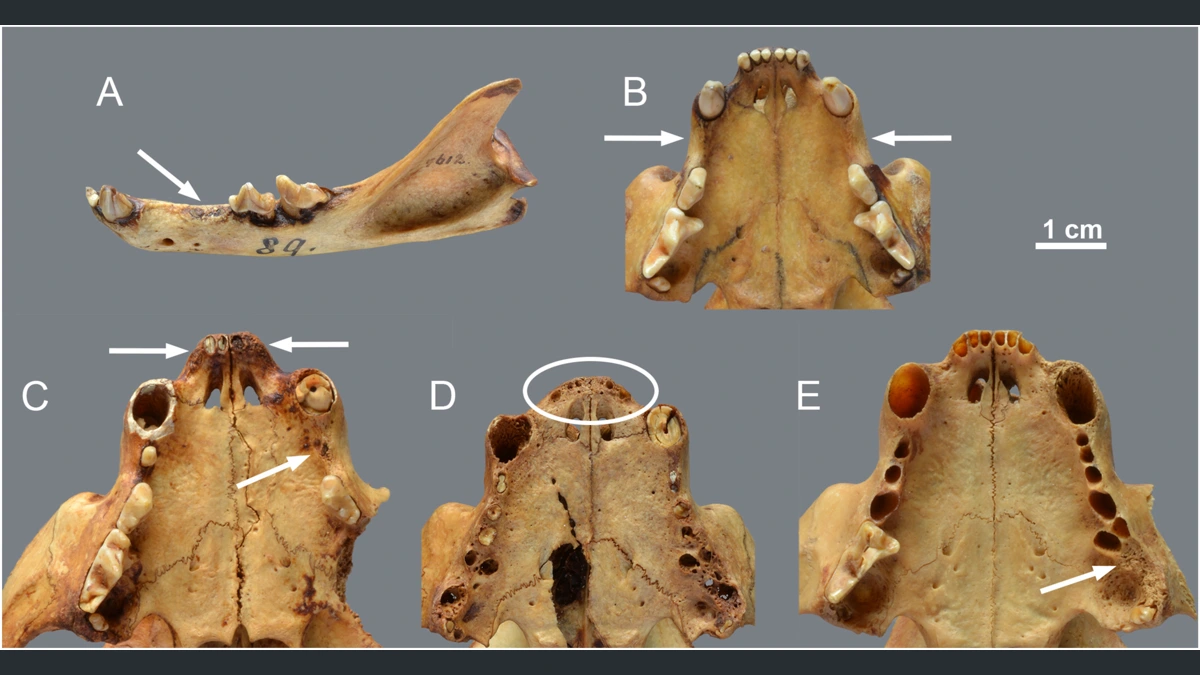
More than half the felids examined showed physical abnormalities. Dental changes were the most common. The authors also recorded healed fractures, punctures and deformations. A healed fracture indicates that an animal survived long enough for the bone to respond. It tells us something about its life, not the cause of its death. A puncture or change in a skull does not preserve the full sequence of events either. For some deformations, infection or a metabolic disorder are possible explanations, not facts established for each case.
Almost all the identified jungle cats showed abnormalities. The authors interpret the combined evidence as consistent with felids kept in similar captive conditions. This does not mean the study found the enclosure or established where each cat lived. It is an interpretation of the marks and the range of animals represented, considered alongside the other evidence.
What chemistry adds
Radiocarbon dating was carried out on nine animals, four jungle cats and five other small felids. Eight were dated to the end of Egypt’s Late Period and the beginning of the Ptolemaic era; one dated to an older period. Nine analyses do not put a date on every skull. They give part of the collection a historical setting, and the outlying result is a reason not to assume that all the remains are the same age.
A second set of tests, on stable isotopes in 16 animals, points to differences in diet or environment. The authors suggest that the jungle cats probably did not reproduce in captivity. That possibility is compatible with some being held together with other cats later on. Where an animal grew up and where it spent time before it died need not be the same place.
The caveat that changes the comparison
Teeth also helped the team estimate the age at which animals died. The Vienna collection contains more adults and subadults than age profiles from research that used X-rays on wrapped mummies. It cannot, therefore, supply a disease rate or an age profile for every cat deposited at Beni Hassan. It does show, specimen by specimen, how a bone, a measurement and an acquisition record each support a different part of the argument. The scale of the English auction can otherwise obscure what the Vienna skulls actually tell us.
Read about the research
The Royal Belgian Institute of Natural Sciences provides the study reference and a summary of its findings.
Becoartes - Beco do Batman
99 Gonçalo Afonso Street, Vila Madalena, São Paulo
Sources and credits
- Wim Van Neer, Bea De Cupere & Claudio Ottoni (2026), Journal of Archaeological Science, Fig. 5; resized and padded, no crop. DOI 10.1016/j.jas.2026.106733. — CC BY 4.0
- Instituto Real Belga de Ciências Naturais
- Relato de 1890 preservado pela National Library of Medicine
- Relato de William Herdman, Liverpool Biological Society