The bell of the Britannic spent more than a century underwater. Bringing it up in 2025 was the most visible part of a job that did not end at the surface. On October 26, 2026, the Municipality of Kea publicised a presentation on the work at the underwater antiquities laboratories in Athens. The recovered objects were undergoing cleaning, desalination, conservation and documentation. The municipality reiterated a plan to display them permanently at the National Museum of Underwater Antiquities in Piraeus but did not say when the objects would be ready for visitors. November 21 marked 110 years since the sinking. The anniversary makes a good point at which to separate the history of the ship from the conservation work that has only recently been made public.
Why the Britannic was in the Aegean
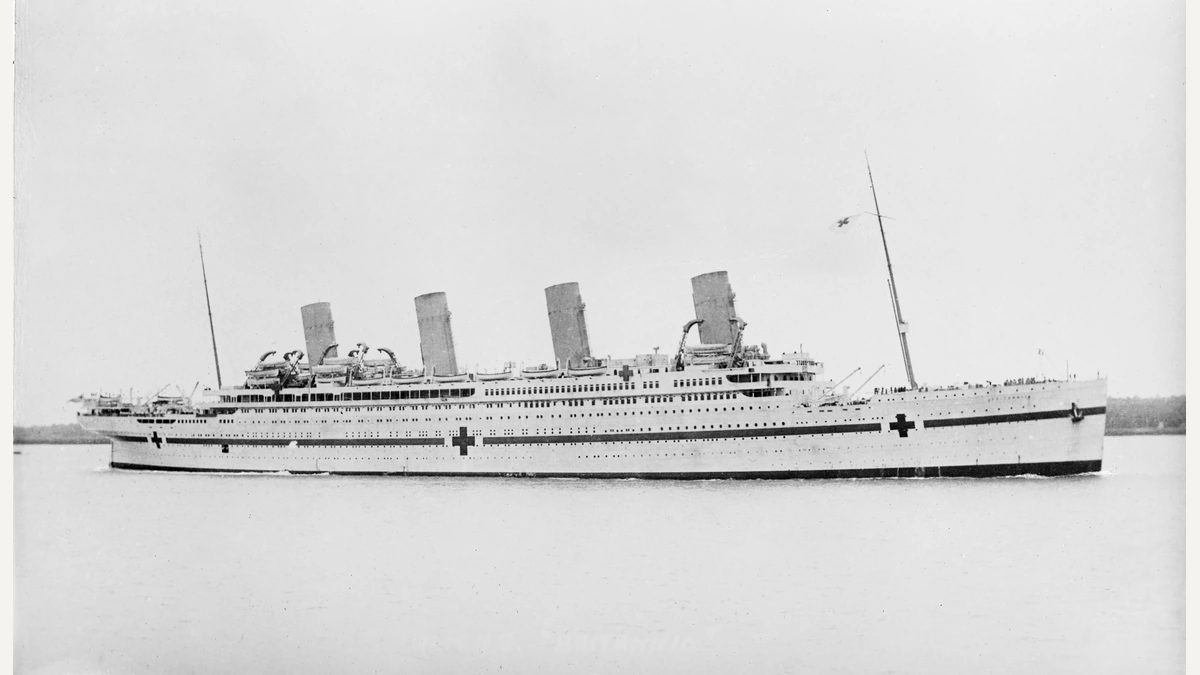
The Britannic was designed as an ocean liner. The British Admiralty requisitioned it for hospital duty in the First World War. On November 21, 1916, on its way towards Lemnos, it struck a mine off Kea. According to the Greek underwater antiquities authority, the ship went down in less than an hour and 30 people died. The wreck inventory published by the Greek Ministry of Culture confirms November 21, the date used here because the 2025 expedition release gives a conflicting day.
The Britannic is often introduced as a sister ship of the Titanic, but the parallel only goes so far. One sank in the North Atlantic on a commercial voyage. The other was lost during a war, after it had been given a different role altogether. That change of purpose is important to understanding the recovered objects: they were aboard a ship designed for one kind of journey and pressed into service for quite another.
Why some objects stayed on the seabed
Between May 6 and 13, 2025, eleven professional divers took part in the authorised expedition at a depth of more than 120 metres. The Greek underwater antiquities authority supervised the operation. The expedition had selected objects in advance, but it did not retrieve everything on the list. The position and condition of some pieces, strong currents and poor visibility all limited what could come up. The expedition report describes this as the first authorised recovery of selected objects from the site, not the first dive on the wreck.
Divers used lifting bags to raise the objects. At the surface, the pieces went into containers prepared for them. The team started removing marine growth before the material went to the laboratory. Landing a piece was not the end of the job: the condition in which it reached shore was already part of the story the conservators had to document.
A bell and a red lamp tell different stories
The lookout bell and the binoculars recall the work of watching the water around the ship. The red port-side lamp did something different: it helped other vessels work out which side of the Britannic they were looking at. The expedition’s release includes images of both objects and calls attention to details such as the lamp’s manufacturer markings. Even when the purpose of an object is obvious, markings can add particulars that a photograph of the whole ship could never show.
The Turkish bath tiles, on the other hand, belong to the story of the original design. They were found detached, according to the expedition. There is no need to picture an intact room on the seabed. A fragment identified as part of its decoration lets us recognise a space we could never make out in a photograph of the ship’s silhouette.
Work continued in Athens
Seawater can leave salts in porous material, joints and small cavities. Removing an object from the sea does not automatically halt deterioration. The desalination mentioned by the municipality is part of stabilising objects so they can be studied and preserved ashore. Ceramic and metal present different conservation questions, and the municipality did not publish a timetable for each object. Nor does a photograph taken after recovery demonstrate that an object is ready to be put on show.
What is known about the museum display
The announced destination is the permanent exhibition in Piraeus, in a section on the First World War. The 2025 expedition report already outlined that intention; the October 2026 municipal update again identified the museum as the next destination. Taken together, the two sources draw a line between three stages: recovery, work in the laboratory and public display. The first two are documented. For the third, visitors still need a date from the museum, not a date inferred from the recovery or from the anniversary.
Read the update from Kea
The October statement explains the work being done in Athens and identifies the museum in Piraeus as the next destination.
Becoartes - Beco do Batman
99 Gonçalo Afonso Street, Vila Madalena, São Paulo
Sources and credits
- Allan C. Green / State Library Victoria, H91.325/996 — Public domain
- American National Red Cross photograph collection / Library of Congress, LC-DIG-anrc-10937; prints loaned by Kadel & Herbert — No known restrictions on publication (Library of Congress rights advisory)
- Município de Kea, comunicado de 26/10/2026
- Ephorate of Underwater Antiquities, relatório da expedição de 2025
- Ministério da Cultura da Grécia, inventário de naufrágios