Two patches of debris from the same exploded star have yielded quite different dust. Silica, a compound of silicon and oxygen, dominates one; carbon dominates the other. For astronomers trying to reconstruct the life of the star that made Cassiopeia A, the difference is more useful than a single inventory of everything in the cloud. It points to material from different burning layers mixing inside the star shortly before its core collapsed.
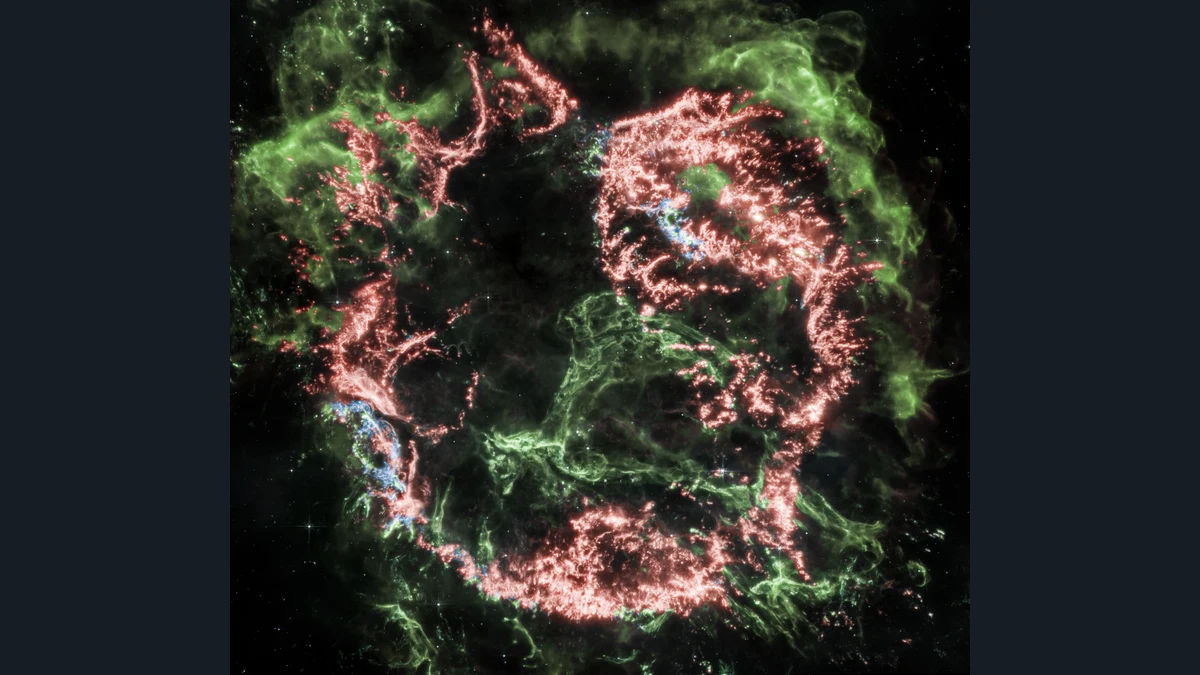
The evidence comes from observations with the James Webb Space Telescope. A team led by Columbia University's Tea Temim published the results on November 23 in *The Astrophysical Journal Letters*. The striking colours in the accompanying portrait aren't what clinched the case. What mattered was being able to distinguish small knots of dust from their neighbours and ask what each contained. Small, in this context, can mean roughly the size of our solar system.
What the older telescope got right
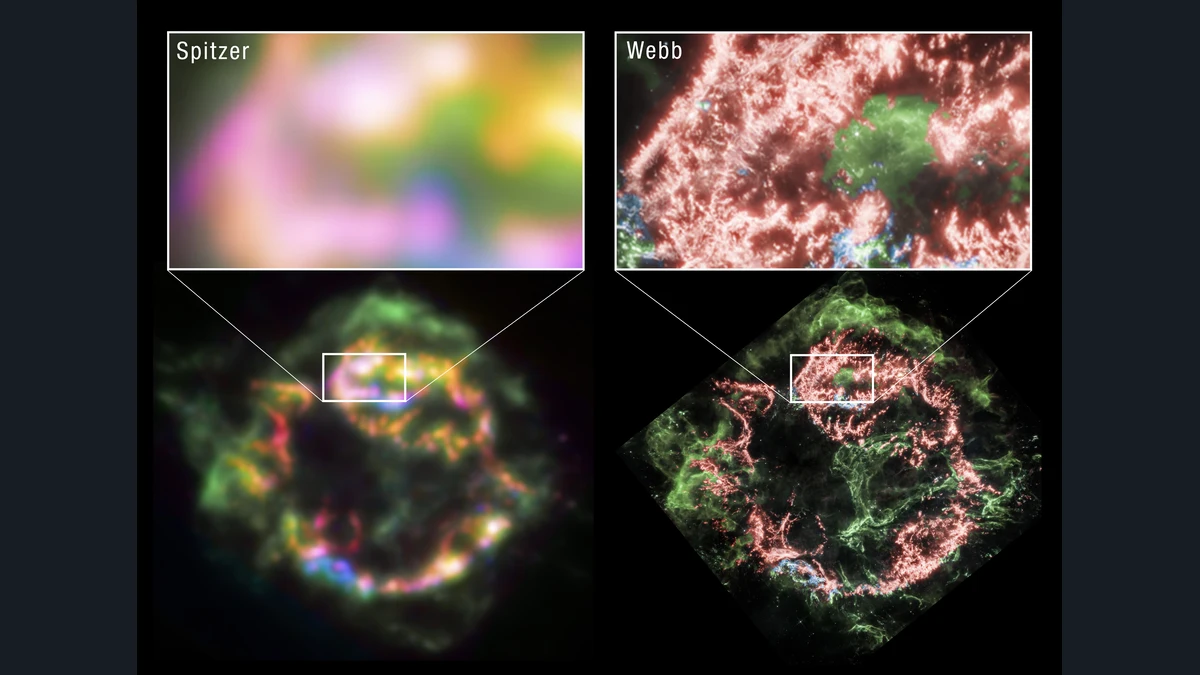
Start with the two-panel picture that places the retired Spitzer telescope's view beside Webb's. Find the white box near the top of each remnant and follow it to the enlarged panel. In the older view, bright patches stand out without showing much internal structure. In Webb's version, those patches break into separate knots and strands. Both telescopes were looking at the same object. The softer image had already done an important job: it showed the team where to point next.
Resolution matters when taking chemical measurements, not just when making attractive pictures. If two paint colours sit side by side but your detector sees only the entire palette, a reading that looks like a single shade can be a blend. Separating the two spots lets you test which interpretation fits. Spitzer helped identify three targets for Webb; the newer telescope's Mid-Infrared Instrument enabled the team to examine the dust in much finer detail. The published colours represent infrared light, not a view a human eye could see through a window.
Three targets, two different origins
Two of the targets lie among the material that the explosion hurled outward. As debris expands and interacts with its surroundings, a shock travels back through the ejecta. Astronomers call this the reverse shock. It heats the material, and the warmed dust gives off infrared light. Measuring how that light varies with wavelength helps researchers work out which types of grains could have produced it. This is where the team found a silica-rich region and a carbon-rich one.
The third target has a name that is hard to miss: the Green Monster. It contains complex magnesium silicates, but treating it as another sample of the exploded interior would give the wrong answer. Its material was shed by the star before the explosion. A structure can appear projected inside the same bright ring as the ejecta and still have an entirely different history. The origin of each patch matters as much as its chemical signature.
A star is not quite an onion
Different fuels burn in different parts of a massive star. Conditions in the core change as one fuel runs short and the core contracts. Nuclear reactions that require higher temperatures can then take place deeper inside, while other reactions continue in layers further out. Cut an onion in half and you get a useful picture of nested shells. But onion rings sit still. In a star, material circulates, and the boundaries between neighbouring burning zones need not remain intact.
Mix material from an oxygen-burning shell and a carbon-burning one, and the star will not eject the same chemical mixture as it would if the two remained separate. That changes the ingredients available when solid grains subsequently condense. The team worked in the other direction, using the dust found today to constrain which arrangements inside the star make sense. It is not a claim that the grains were sitting inside the star in their present form. Nor did Webb catch the act of mixing on camera.
The difference between evidence and a clock
X-ray observations, including work with Chandra and the Japanese-led XRISM mission, had already provided evidence for a shell merger. The new study asks a related question of a different component: dust rather than just the hot gas. Mapping the remnant placed the merger signature across much of it. Agreement between the two approaches makes a stronger case than a striking resemblance in a single patch would.
Cassiopeia A lies roughly 11,000 light-years away; light from the explosion reached Earth centuries ago. The suggestion that the mixing took place perhaps only hours before collapse is an interpretation of the star's evolution, not a measured countdown. That distinction is a strength of the result. It sets out a test that can be tried on debris elsewhere: locate the grains, distinguish the material expelled in the explosion from what was already outside, and ask whether their chemistry preserves a history that the surviving gas alone cannot tell.
Image credits. Images resized, framed with margins and converted to WebP without cropping. NASA, ESA, CSA, T. Temim (Columbia University), R. Arendt (UMBC), D. Milisavljevic (Purdue University). Image Processing: J. DePasquale (STScI). (CC BY 4.0); NASA, ESA, CSA, JPL-Caltech, T. Temim (Columbia University), R. Arendt (UMBC), D. Milisavljevic (Purdue University). Image Processing: A. Pagan (STScI). (CC BY 4.0).
Sources for this story
Original documents are linked in the article.
Becoartes - Beco do Batman
99 Gonçalo Afonso Street, Vila Madalena, São Paulo
Sources and credits
- NASA, ESA, CSA, T. Temim (Columbia University), R. Arendt (UMBC), D. Milisavljevic (Purdue University). Image Processing: J. DePasquale (STScI). — CC BY 4.0
- NASA, ESA, CSA, JPL-Caltech, T. Temim (Columbia University), R. Arendt (UMBC), D. Milisavljevic (Purdue University). Image Processing: A. Pagan (STScI). — CC BY 4.0
- Tea Temim et al. | The Astrophysical Journal Letters
- ESA/Webb | Cassiopeia A
- NASA | Cassiopeia A
- Chandra X-ray Center | Cassiopeia A