Trace the bottom half of the eye first. It follows the shore of a dark lagoon, its curve picked out by pale sand. Trace the top half and you are suddenly following the Milky Way. In the photograph selected by Astronomy Picture of the Day on November 26, Ignacio Fernández makes those two lines look as though they were drawn for each other. Yet one owes its shape to a camera lens; the other is part of a stretch of the Brazilian coast that refuses to hold still.
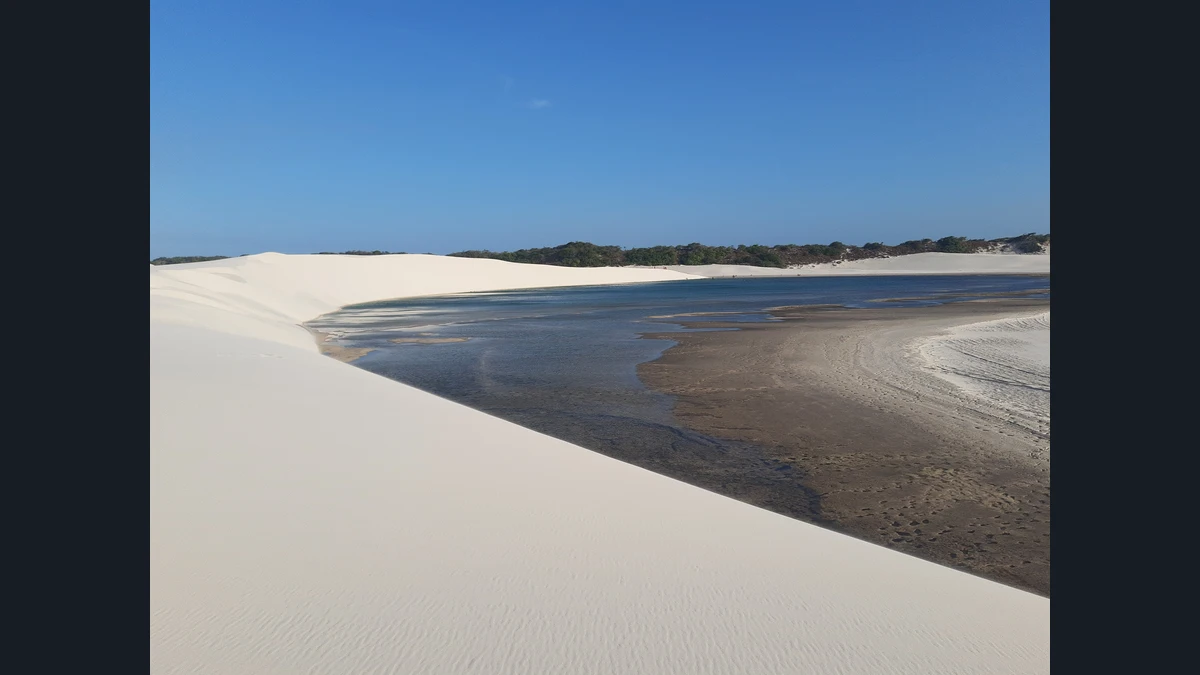
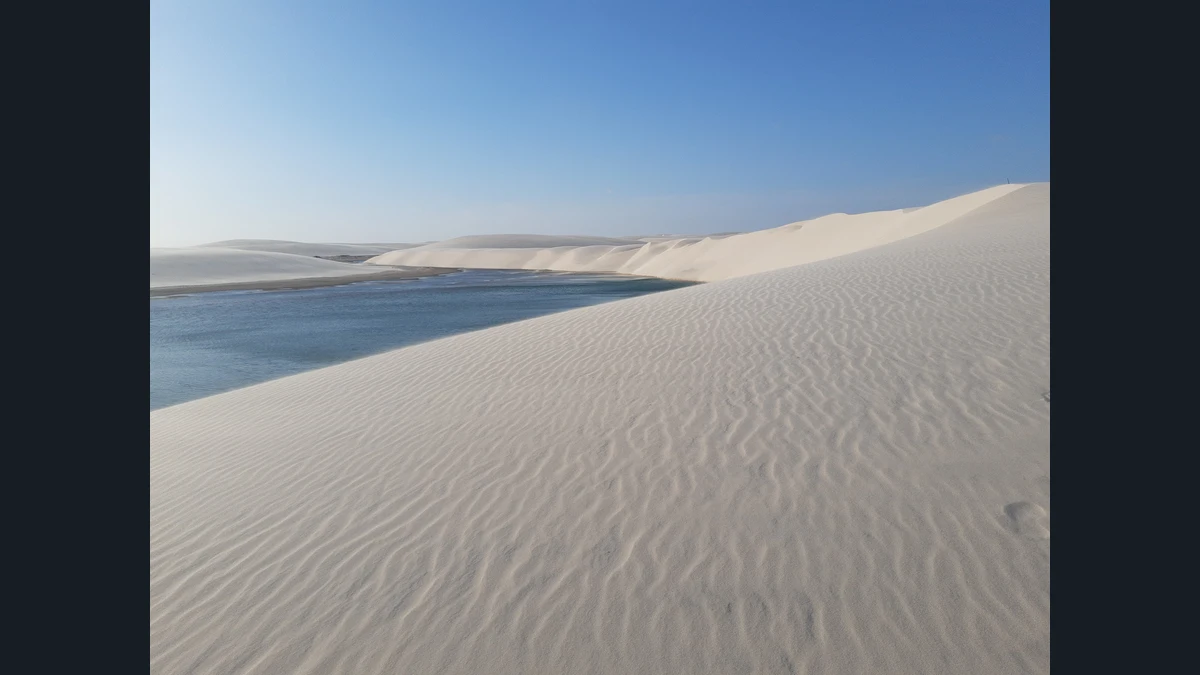
See Fernández’s original composition on NASA’s website. NASA credits the photographer as the copyright holder. The two archive pictures accompanying this article are separate views of Lençóis Maranhenses National Park, taken by Gerda Arendt in November 2024. They offer a closer look at the shape of a lagoon from the ground; they do not show the specific location of the night photograph.
How a flat photograph changes the sky
November is the publication date, not the date of that night under the stars. The APOD editors describe a composite made late at night in July, about two degrees south of the equator. The light across the sky is our own galaxy seen from within. Looking towards the disk of the Milky Way means looking along the directions in which many of its stars are concentrated. That is why we see a band rather than the face-on spiral familiar from illustrations of our galactic home.
Why does the band arch like a rainbow? The explanation accompanying the picture points to the wide-angle lens. A large sweep of sky has to fit inside the flat borders of a photograph. How lines appear depends on the projection and on where the photographer points the camera. The arc is not an outline of the galaxy bending down to meet the water. Cover the landscape with your hand and a ribbon of stars remains. Uncover the shoreline and the same ribbon suddenly looks like an eyelid. That last step belongs to the viewer.
Read the darkness as well as the light
Even on a small screen, the band is far from uniform. The APOD editors identify dark dust lanes and colourful nebulae. Dust between an observer and distant stars can obscure some of the light coming from behind it. A dark lane need not be an empty lane. Looking only at the brightest sections of the picture means missing much of the structure that makes the band recognisable in the first place.
The dark water is doing a different job. You do not need to identify a single reflected star to see the eye. What matters is the boundary between lagoon and sand. That is worth looking for before zooming in on the sky: the picture works at the scale of an entire landscape before the astronomical details even come into focus. A good test is to imagine the same sky above a straight horizon. The galaxy would be as interesting, but the eye would not be there.
The part that wind and water draw
Lençóis Maranhenses occupies a stretch of the eastern coast of Maranhão in northeastern Brazil. A tight frame filled with white dunes can make it look like a desert. Rain is the missing piece of that view. During the rainy season the water table rises, filling hollows between the dunes. Some lagoons are temporary and others persist. The sea nearby is not a tap supplying these pools; the water comes from rain.
The Atlantic does help explain the sand. Tides deposit sediment along the beach, and wind picks up grains and carries them inland. Over time, dunes form winding chains. As sand moves and water levels change, the outline of a lagoon can change with them. Try to imagine returning with a print of a particular shoreline and holding it up against the view. Getting back to the coordinates is one thing; finding precisely the same curved edge to frame is another.
A national park larger than the viewfinder
The UNESCO World Heritage listing puts the landscape into perspective. The property, inscribed in 2024, covers 156,562 hectares, including roughly 90,000 hectares of dune field. Its coast runs for about 80 kilometres. The park also contains mangroves, rivers and coastal vegetation known as restinga. People live within its boundaries. A photograph in which no settlement is visible should not be mistaken for a portrait of uninhabited land.
Go back to the original and look at the narrow strip where sky and ground meet. The photograph brings together a part of a galaxy seen from its interior, a camera’s way of rendering an enormous field of view, and a contour shaped by water and moving sand. Each can be understood without the others. Put them together at just that point and a fourth thing appears: the eye. It is an apt subject for a place where the most memorable line in a picture may no longer be there the next time the photographer visits.
Image credits. Images resized, framed with margins and converted to WebP without cropping. Gerda Arendt (CC0 1.0); Gerda Arendt (CC0 1.0).
Sources for this story
Original documents are linked in the article.
Becoartes - Beco do Batman
99 Gonçalo Afonso Street, Vila Madalena, São Paulo