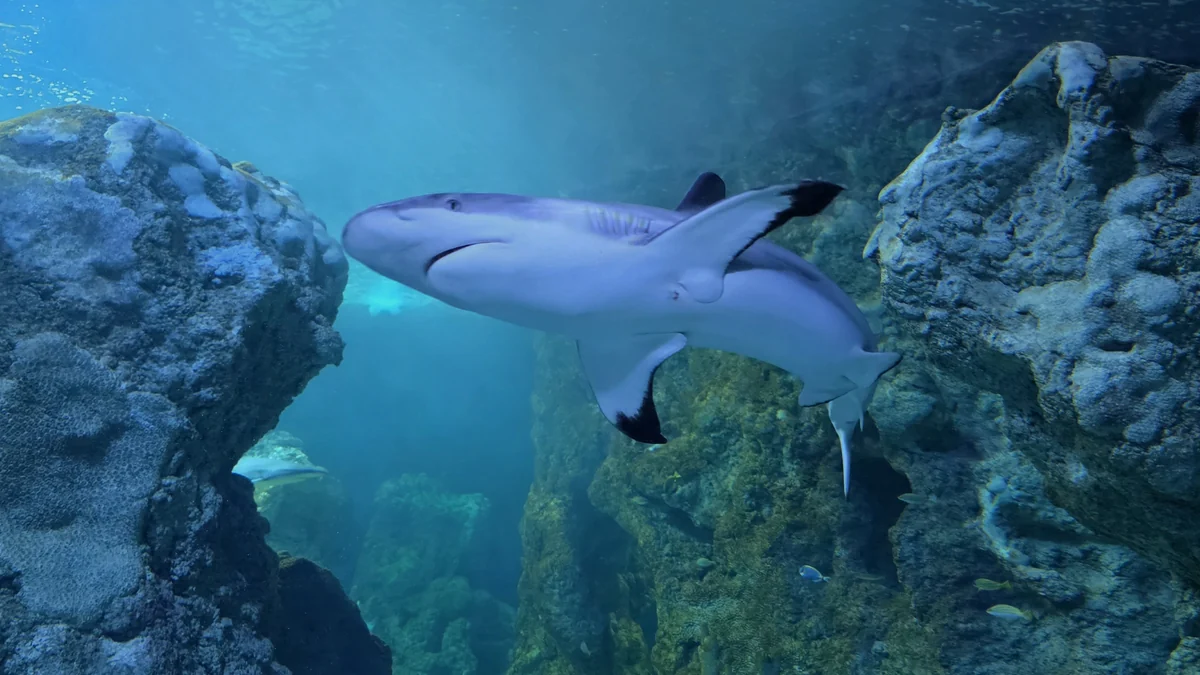
The two new female blacktip reef sharks are in the Lagoon Pass aquarium within Nausicaá’s Échappée tropicale exhibition in Boulogne-sur-Mer. They joined eight other members of the species, bringing the group to ten. Look for black tips or edges on the fins and relatively active swimming. The same habitat contains whitetip reef sharks, which the institution describes as calmer, more discreet and inclined to stay near the bottom.
That comparison helps identify the species, but it does not reveal exactly which animals are the two newcomers. Nor is there any guarantee that every individual will be visible at a particular time. Check the official Nausicaá website for changes before planning a visit.
What arrived at Nausicaá
The two females arrived on November 10, 2026. Born in an aquarium in 2020, they are not yet sexually mature and have joined the group housed in the Lagoon Pass. According to the center’s announcement, the transfer was part of cooperation and exchanges between aquariums.
Their arrival brings the group to seven females and three males. Nausicaá says the first eight animals joined in September 2025, when Échappée tropicale opened. The two additions contribute to the renewal of this population in human care.
There is a numerical discrepancy worth noting. The current announcement refers to eight previous animals, while a page published in September 2025 mentioned nine. For the present situation, the latest explicit figure is a total of ten.
Where to look inside the aquarium
The designated location is the Lagoon Pass, a habitat representing the transition between a lagoon and the open sea within Échappée tropicale. Nausicaá lists its address as Boulevard Sainte-Beuve, 62200 Boulogne-sur-Mer, France.
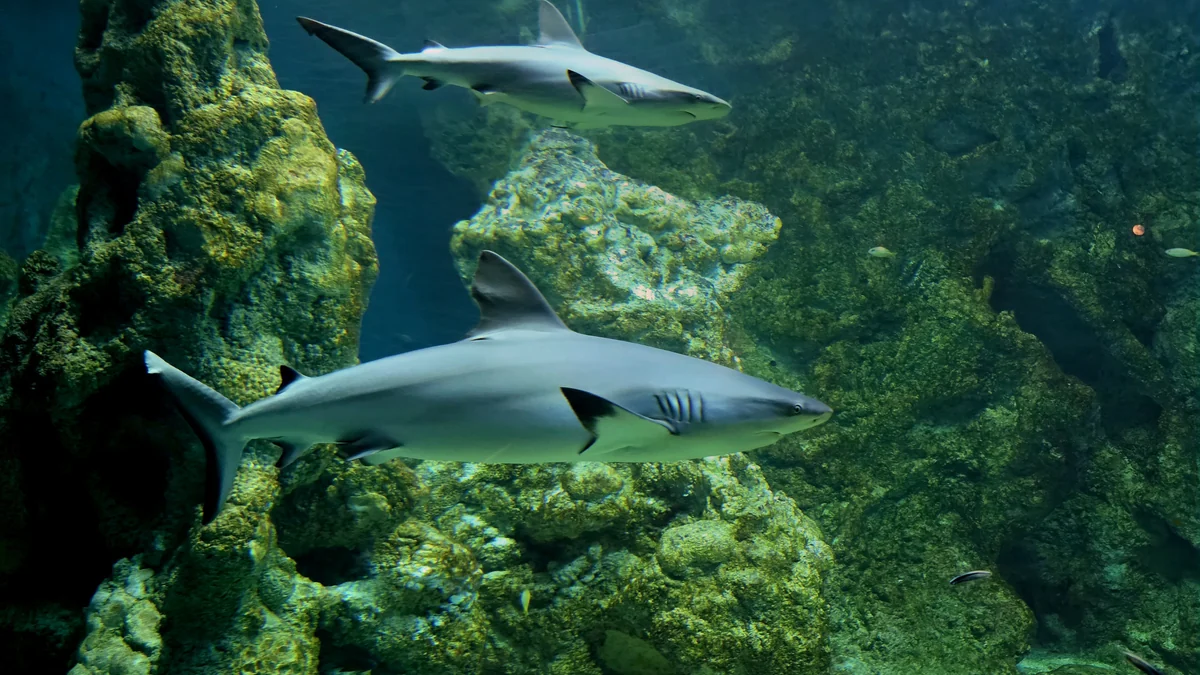
The blacktip reef sharks share the aquarium with whitetip reef sharks, fusilier fish, batfish and a giant grouper. This provides a useful practical warning: visitors should not expect an enclosure occupied only by the newcomers, and not every shark visible there belongs to the same species.
The stated location confirms where the group is kept, not that a sighting is assured. Animals in a large habitat may move out of view, and the sources provide no preferred viewing time.
How to tell blacktips from whitetips
The blacktip reef shark (*Carcharhinus melanopterus*) has conspicuous dark borders or tips on its fins. Nausicaá’s guide to its sharks also describes it as a lively, small reef shark. The combination of black fin markings and active movement is therefore the most useful visual reference.
The whitetip reef shark is described as calmer and more sedentary. It tends to stay near the bottom and may be harder to spot. For a careful identification, check the color at the ends of the fins first and treat behavior only as supporting evidence: a single moment of rest or movement cannot establish the species.
The public information provided does not make it possible to identify the two new females individually. In 2025, Nausicaá said keepers would prepare a reference record of each shark’s distinguishing features, but the sources reviewed do not publish that catalog.
What “Vulnerable” means
Nausicaá identifies the species as Vulnerable on the IUCN Red List and cites overfishing, coastal habitat degradation and pollution among the threats it faces in the wild. The species inhabits shallow tropical waters in the Indo-Pacific, including reefs, lagoons and coastal areas.
In IUCN Red List terminology, Vulnerable, Endangered and Critically Endangered species are collectively described as threatened. A category indicates extinction risk under criteria that consider factors such as geographic range, population size and population trend. It does not mean that every individual was taken from the wild, nor does it predict when extinction might occur.
These two females were born in an aquarium. Their move to Nausicaá should therefore not be presented as the capture or rescue of wild sharks.
What the European EEP does
Both blacktip and whitetip reef sharks in the Lagoon Pass are covered by EAZA Ex Situ Programmes, or EEPs. Nausicaá participates in both and coordinates the programme for the whitetip reef shark.
EAZA explains that each EEP collectively manages a population distributed among zoos and aquariums. Coordinators and committees evaluate genetic and demographic records and may recommend whether an animal should stay, move, breed or refrain from breeding. The aim is to maintain demographically stable, genetically diverse populations that can fulfill each programme’s defined roles.
This defines the transfer’s significance: moving animals between institutions can help manage the composition and diversity of a population in human care. The available sources do not announce that these two females will be released into the wild. EAZA makes clear that reintroduction is only one possible role of an EEP and depends on specific conditions, including suitable habitat and the control of threats.
What visitors can observe—and what they cannot conclude
The most reliable approach is straightforward: find the Lagoon Pass, look for fins with black tips and compare the blacktips’ active swimming with the whitetips’ more discreet, bottom-oriented behavior. The current group contains ten blacktip reef sharks, but visible appearance alone does not automatically identify the November arrivals.
For conservation, the key fact is not simply that the group has grown. The new females belong to a population coordinated across institutions, with decisions informed by records and long-term objectives. Such management can preserve genetic diversity; it is not, by itself, an announced project to release these sharks into the sea.
Discover Becoartes
Visit [Becoartes](https://becoartes.com/) at Rua Gonçalo Afonso, 99, Vila Madalena, São Paulo.
Becoartes - Beco do Batman
99 Gonçalo Afonso Street, Vila Madalena, São Paulo
Sources and credits
- JensKunstfreund — CC BY-SA 4.0
- JensKunstfreund — CC BY-SA 4.0
- Nausicaá — Deux requins à pointes noires rejoignent Nausicaá
- Nausicaá — Les requins de Nausicaá : les avez-vous tous vus ?
- Nausicaá — Des requins à pointes noires rejoignent l’exposition Échappée tropicale
- EAZA — Healthy animal populations and Ex Situ Programmes
- IUCN Red List — significado da categoria Vulnerable