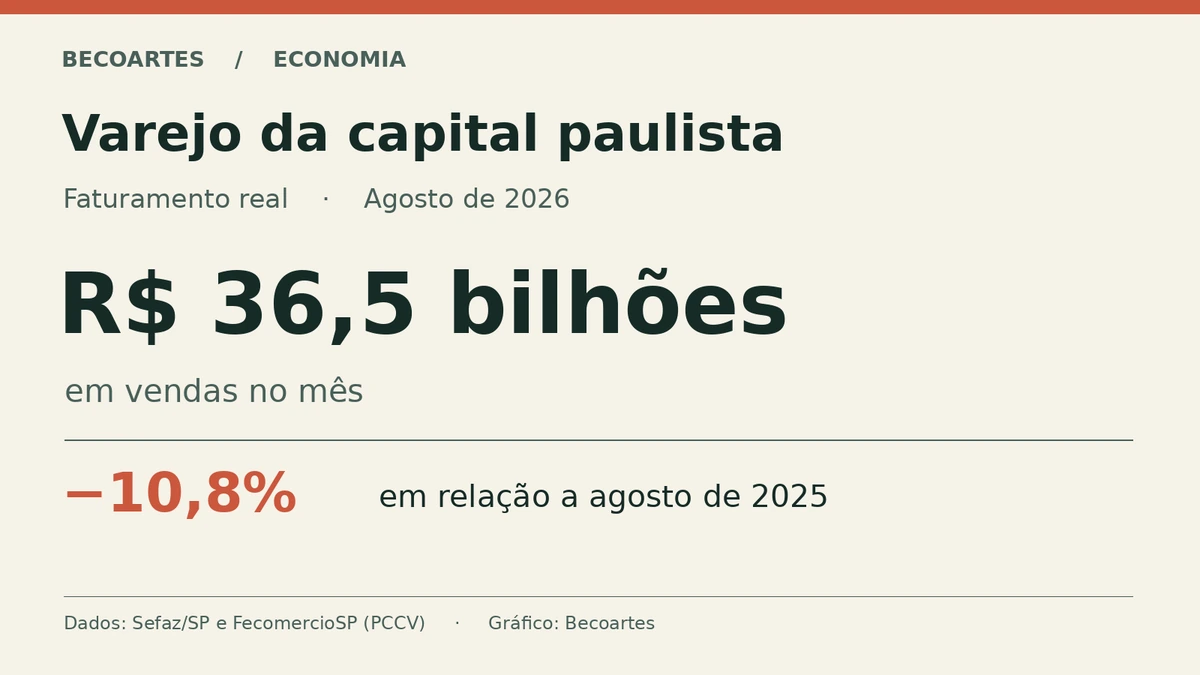
São Paulo city retailers took in R$4.4 billion less in August 2026 than in August 2025, after adjusting for inflation. That is a difference in sales, not a calculation of business losses. FecomercioSP published the figures on November 19 using state treasury data. The city’s retailers recorded R$36.5 billion in sales for the month. From January through August the shortfall compared with the same eight months a year earlier reached R$30.4 billion.
Why the number for the city differs from the state figure
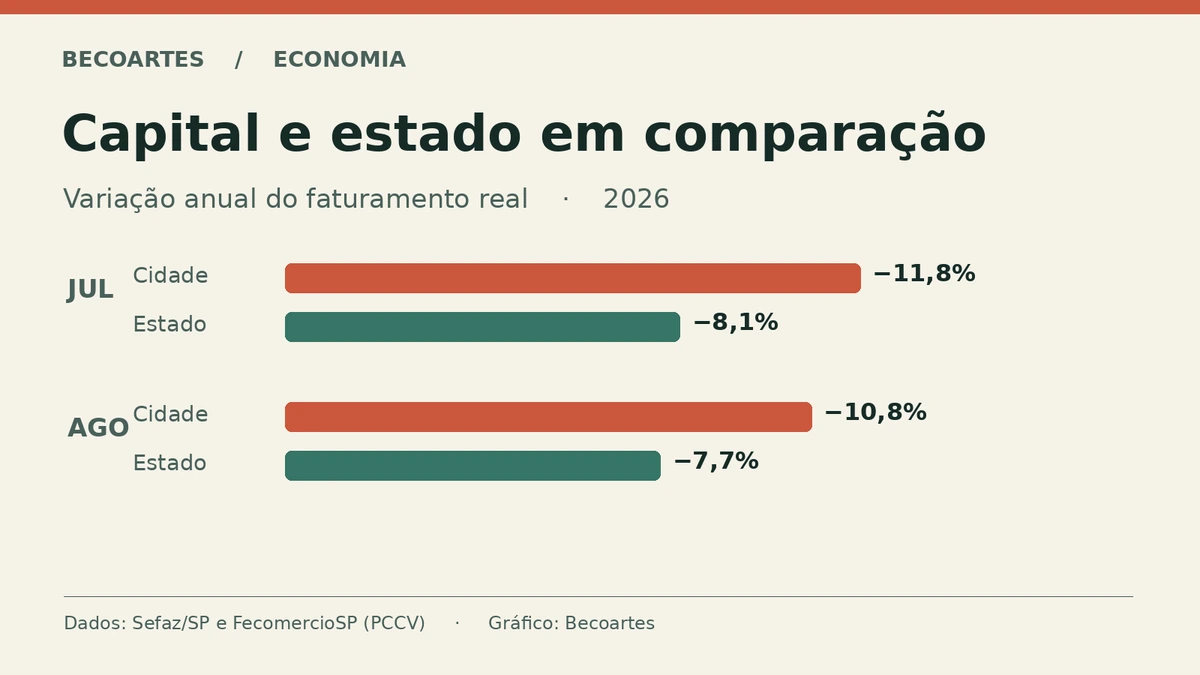
The 7.7% decline in the survey headline covers the entire state. Sales in the city fell 10.8%. These are two geographical cuts of the same survey, and the state figure already includes the capital. Adding the two losses would count the city twice. The 3.1 percentage point gap shows that retail revenue in the capital fell faster than the state average, but it cannot tell us why.
Car dealerships offer a particularly clear example. Statewide, the sector posted a 6.8% gain; within the city it posted a decline of less than 0.1%. For someone assessing conditions at a São Paulo showroom, relying on the state figure alone would reverse the direction of the comparison.
What a drop in receipts tells a shopkeeper
None of the nine retail categories tracked in the city recorded growth in August. Electronics and appliance stores and department stores, measured as one group, lost 37% of their inflation-adjusted revenue. Supermarkets recorded an 8% decline. The first figure is not a count of appliances left on the shelves. Revenue depends on how many items people buy, the prices they pay and the kinds of products they choose.
Consider two grocery baskets that cost the same at checkout. One might contain fewer, more expensive brands; the other might hold more items bought on promotion. The identical totals do not reveal either customer's choices. The same distinction matters for the citywide decline: it measures the value of sales, not the number of customers who stayed home.
Did conditions improve between July and August?
City retailers recorded R$35.9 billion in July, 11.8% below July 2025. The year-on-year decline in August was one percentage point smaller. These are comparisons with two different months a year earlier. A smaller decline does not establish a recovery. Each month has its own calendar, promotional activity and starting point for a comparison.
From January through July, the cumulative shortfall had stood at 9.2%. Adding August brought it to 9.4%. That does not conflict with a narrowing monthly decline. August was still 10.8% below August of the previous year, a worse showing than the first seven months combined. A month can outperform July on this measure and still drag down the year-to-date result.
What households told interviewers in October
A separate FecomercioSP survey asks city residents about their willingness to spend. The overall index stood at 109.2 points in October. Within it, the measure of current consumption stood at 86, while the reading for future consumption reached 106.3. On this scale, 100 is neutral. Households' assessments of the present and their expectations for the future landed on opposite sides of the line.
These responses are not a forecast of Christmas receipts. Someone can expect to be in a better position to buy something in a few months without making a purchase today. The October survey offers context for the August treasury figures; it neither updates those sales nor supplies the missing results for November.
Employment and sales answer different questions
In September, Brazil’s Novo Caged employment register counted 251,013 formal hires and 245,109 employment separations in the city. The difference was a net gain of 5,904 positions across all activities, not 5,904 jobs created in retail. A gain in employment need not contradict a decline in sales: the figures cover different months and different activities, and they measure different events.
For a neighborhood store, a useful comparison starts with three numbers from the same period of each year: how many transactions it recorded, how much customers spent per purchase and what margin the business retained. A store with steady transaction volume and a lower average purchase faces a different question from one that retained its average ticket but lost foot traffic. For a bar or restaurant there is a further limitation: a retail sales table does not measure food-service revenue.
Find your sector
Table 2 of the FecomercioSP survey breaks down the nine retail categories in the city.
Becoartes - Beco do Batman
99 Gonçalo Afonso Street, Vila Madalena, São Paulo