A prisoner whose name was not disclosed, a governor who brought him along and a black velvet mask: that is what the Bastille records let us describe. The iron mask and the secret relationship to Louis XIV belong to the later life of the story, not to the official entry recording the prisoner’s death. That distinction does not solve the mystery. It shows where the mystery begins.
1698: the governor arrives with a prisoner
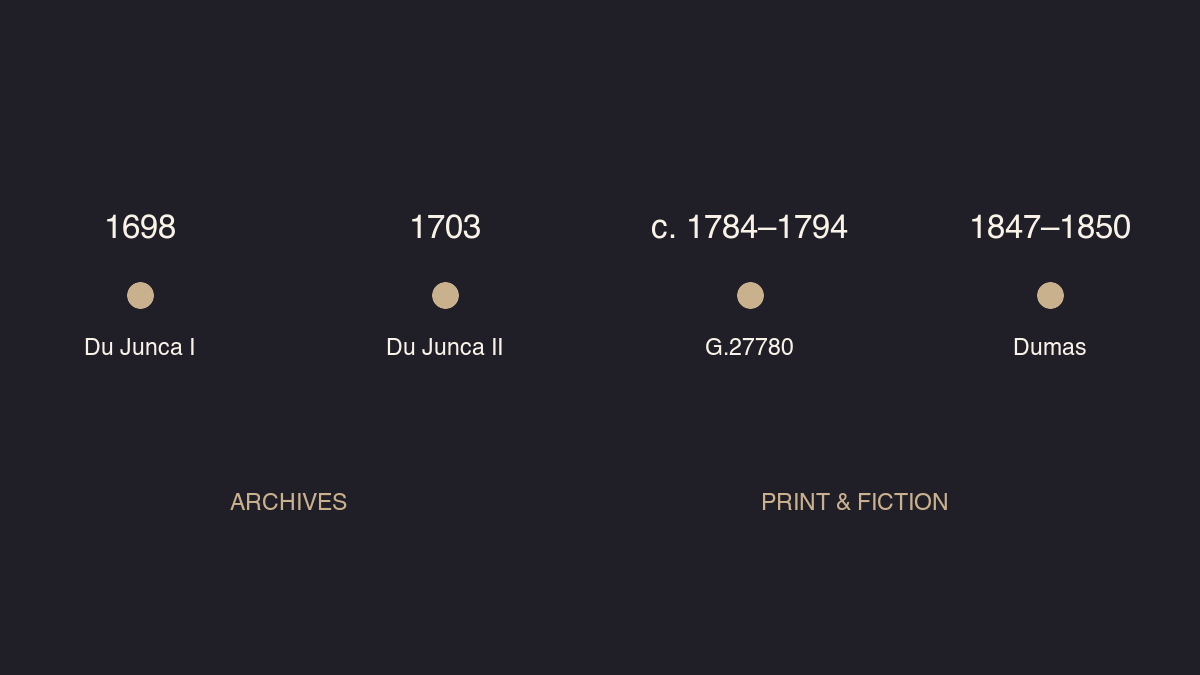
The first of the two books written by Étienne du Junca, the king’s lieutenant at the Bastille, records Saint-Mars’s arrival on September 18, 1698. The governor had come from the Lérins islands and brought a man already in his custody. The entry links the prisoner to an earlier stay at Pignerol. Du Junca says his name was not disclosed and describes moving him into a cell. The record offers no civil name for the reader to look up elsewhere.
An administrative register helps establish particular events, not every possible explanation for them. Arrival, custody and accommodation let us place someone at a particular moment. They do not tell us why he was imprisoned or whether du Junca knew the explanation later writers sought. If a man is identified through his relationship to the governor, cross-checking references to Saint-Mars is a start. It is not enough to turn every prisoner in his care into the same person.
1703: the entry that names the material
On the back of folio 80 in the second book, the entry dated November 19, 1703 reports the unknown prisoner’s death at the Bastille. Du Junca again links him with Saint-Mars and describes a black velvet mask. This is a stronger starting point than the later fame of the story: a specific description by an official working at the prison. But it is a description, not the physical object. It cannot establish its precise construction, let alone the materials of every covering the man may have worn over years in custody.
It is tempting to say this proves he “never wore iron.” The entry does not establish that. Its narrower point is more useful: the material named here is not iron. Similarly, saying that the prisoner was kept masked is not the same as having observed him at every hour. A description of prison practice and an absolute claim about his entire life call for different evidence.
How iron became part of the story
In *The Age of Louis XIV*, Voltaire made the masked prisoner a memorable figure in the history of the reign. His eighteenth-century account describes steel springs at the chin. That detail belongs to Voltaire’s narrative; it is not a transcription of the entry about velvet. The image of a metal covering made the secret tangible in a way an official’s note about an arrival and a death did not.
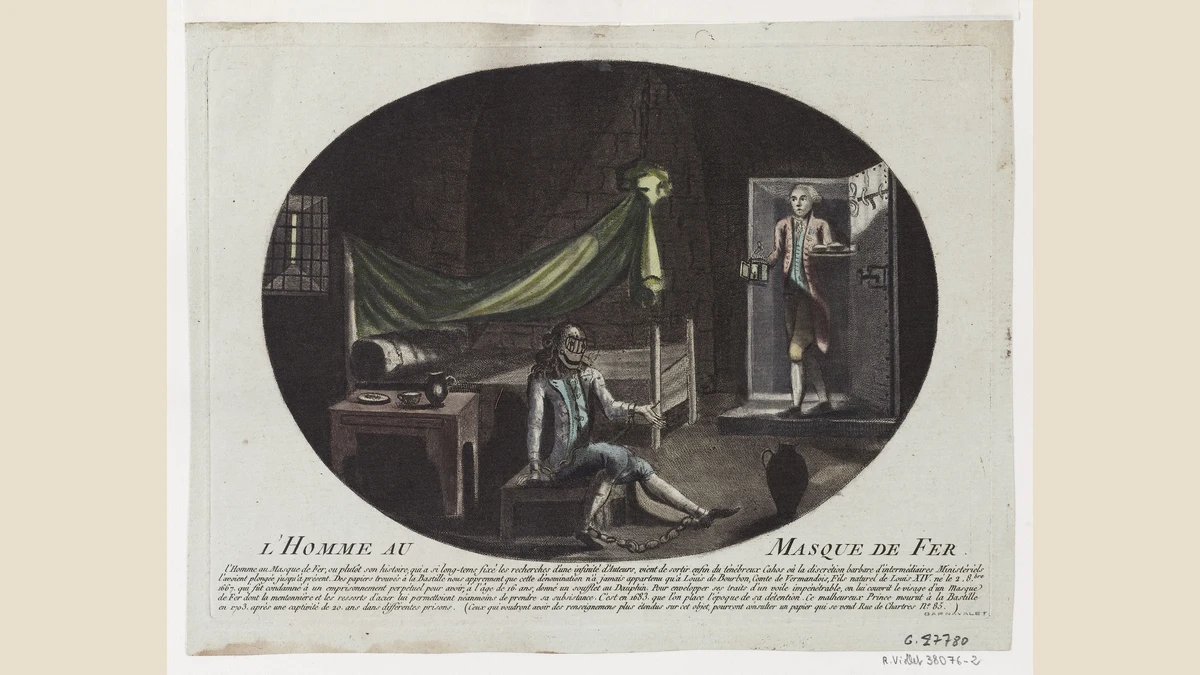
An anonymous print dated to about 1784–1794 at the Musée Carnavalet shows how the story grew. The inscription on the print puts forward the Count of Vermandois as the prisoner. That tells us what the print claimed, not who was in the cell. Later, Alexandre Dumas made a twin brother of Louis XIV central to the plot of *The Vicomte de Bragelonne*. The explanation works as fiction because it gives the secrecy a motive. Literary strength is not documentary proof.
What to take away from the archive
Ask each source a different question. Use the register to check the dates and the official description. Use Voltaire to see how the metal-mask story circulated. The print shows a theory someone wanted the public to see. Dumas shows what fiction can do with a gap in the record. That does not make the later sources worthless; it means that they answer different questions from the prison register.
What survives this test is clear: Saint-Mars brought a prisoner to the Bastille in 1698; the prisoner died there in 1703, and the death entry describes black velvet. The sources cited here do not establish his identity or confirm that he was the king’s brother. The legend is part of the episode’s history, not a proven biography of the man.
Bibliothèque nationale de France
Two registers, a print and a novel: where the documentary record ends and the masked prisoner’s legend begins.
Becoartes - Beco do Batman
99 Gonçalo Afonso Street, Vila Madalena, São Paulo
Sources and credits
- Paris Musées / Musée Carnavalet – Histoire de Paris, G.27780 · CC0 1.0 — CC0 1.0
- Guia Cultural Becoartes · diagrama original — Original editorial artwork prepared for Becoartes
- Bibliothèque de l’Arsenal / Biblissima · Ms-5134, fol. 80v
- Gallica · fac-símile do segundo registro (consulta, não reutilizado)
- Marius Topin · transcrição histórica dos dois registros de Du Junca (edição digitalizada)
- Bibliothèque nationale de France · dossiê Bastille, Le Masque de fer
- Ministère de l’Éducation nationale · excerto de Voltaire, Le Siècle de Louis XIV
- Gallica · folhetins de Alexandre Dumas
- CC0 1.0