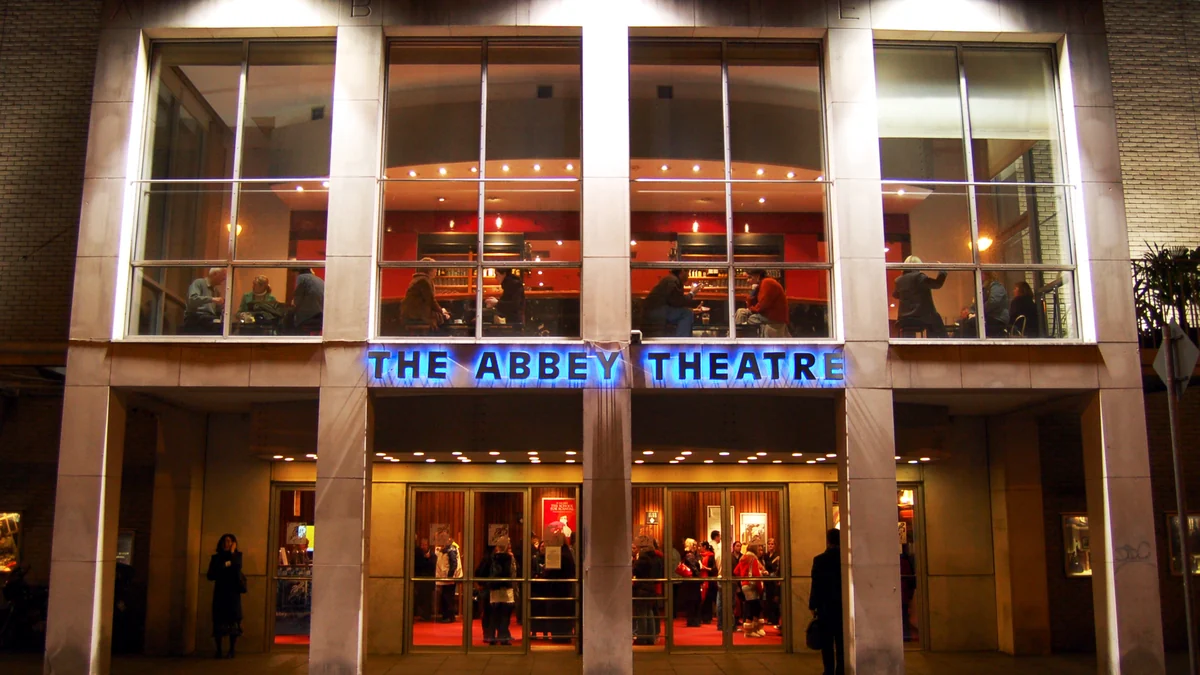
The most concrete reason is Ulster American, the play by David Ireland directed by Ciaran O'Reilly, staged at the Abbey Theatre in Dublin for a limited run from August 12 to 22, 2026. The production brings together Matthew Broderick, Geraldine Hughes and Max Baker in a three-character satirical comedy. According to coverage from RTÉ and the Abbey Theatre itself, the plot begins with a meeting on the night before rehearsals start: a famous American actor, an Ulster-born playwright and an English director need to talk about a play dealing with Northern Ireland. What seemed like an artistic meeting turns into a minefield.
The trend matters to Becoartes because it moves Broderick away from the comfortable place of cinematic memory. Instead of treating the actor as a celebrity in himself, the story allows us to ask why certain faces from American cinema still work as cultural shortcuts, and what happens when those shortcuts collide with political histories that do not fit into caricature.

The confirmed fact: Broderick in Ulster American
The factual basis is clear. Ulster American ran at the Abbey Theatre, Ireland's national theater, from August 12 to 22, 2026. The Dublin staging was associated with New York's Irish Repertory Theatre and placed Matthew Broderick in the role of Jay Conway, an award-winning American actor who arrives loaded with certainties about an imagined Ireland. Geraldine Hughes plays Ruth Davenport, a Belfast-born playwright who identifies as British, while Max Baker plays the director Lee Carver.
The play's own description already points to the conflict zone. This is not a story about a star visiting a foreign country to be honored. It is a satire about who has the power to represent others, who profits from that representation and what is lost when complex identities are reduced to an accent, a national myth or a gesture of good intention.
In an interview with RTÉ, Broderick said American audiences were confused by the identity distinctions present in the play, especially when Geraldine Hughes's character insists she should not simply be read as Irish. That statement, treated as journalistic record, helps explain why the play moves beyond the theater circuit. The subject is not only Northern Ireland. It is the way distant audiences consume historical conflicts through simplified categories.

The star as character and problem
Broderick's casting is more than attractive billing. It creates a meta layer. A globally known actor plays a famous actor, full of confidence, trying to approach a story he does not master. That turns the star's presence into critical material.
In the 1980s, Broderick became a symbol of a white, urban American youth that dominated exported pop culture. Ferris Bueller spoke straight to the camera, broke rules, escaped obligations and made everything seem light. Forty years later, the same public memory can be used almost in reverse: not as a fantasy of freedom, but as a question about privilege, cultural authority and the limits of sympathy.
The interpretation here needs to be separated from fact. The fact is that Broderick is in a play that discusses identity, ego, theater and cultural misunderstandings. The critical reading is that his public image intensifies the theme. When the audience sees Broderick on stage as Jay Conway, it does not see only a fictional character. It also sees the shadow of Hollywood, the memory of a cinema that taught part of the world to look at the United States as a narrative center and the tendency to reduce other histories to settings for a personal journey.
Identity is not a costume
Ulster American seems to work because it starts from a common trap: the belief that goodwill is enough to represent a culture. The American actor character wants to participate in a work connected to Ireland, but he carries ready-made expectations. The problem is not only ignorance. It is the confidence with which ignorance presents itself as sensitivity.
Recent reviews help map that tension. The Irish Examiner described the production as a satire that draws on Broderick's star power and targets liberal hypocrisies and cultural misunderstandings. The Arts Desk recognized the comic force of the encounter between cultures, although it felt the play delivered more laughs than deep layers. No More Workhorse saw in the staging a strong metatheatrical game, with Broderick using his own persona to embody a self-centered Hollywood idol.
These assessments do not need to agree for the story to be relevant. On the contrary: the disagreement shows that the play touches an open question. Does satire about representation still provoke reflection or does it already sound dated? Does laughter help dismantle certainties or merely organize predictable discomforts? The answer depends on the audience, the context and the willingness to listen to what celebrity, by definition, tends to drown out.
Why it matters in Brazil
The Brazilian rise in searches for Matthew Broderick does not necessarily mean the national audience is following Irish theater in detail. Search trends mix nostalgia, curiosity, algorithms, reruns, lists, memes and international news. Even so, the interest offers a legitimate cultural hook: an actor who shaped many people's audiovisual formation reappears associated with a work about identity and representation.
In Brazil, this discussion finds fertile ground. We are intense consumers of global pop culture and, at the same time, producers of cultures often simplified by outside views. Funk becomes exoticism. Peripheral rap becomes a decoration of authenticity. Street culture becomes a campaign setting. The very image of Sao Paulo is often flattened between violence, gastronomy, business and postcard scenery, as if the city were not a permanent dispute of languages.
That is why the play matters less as an agenda item and more as a mirror. It asks who can speak for whom, but it also asks who is willing to study before speaking. In any cultural scene, including Brazil's, there is a difference between dialogue and rushed appropriation. There is a difference between moving through an aesthetic and understanding the social relations that formed it.
Nostalgia as a door, not a destination
The name Matthew Broderick pulls a powerful pop memory. That does not need to be rejected. Nostalgia can be an entry point into more complex debates, as long as it does not become the final destination. The risk would be to write just another text about how Ferris Bueller's Day Off has aged, or about how Broderick looks different today. That story would be thin because it would treat the actor as an object of memory, not as part of a living conversation.
What Ulster American offers is another path. The play uses the familiarity of the star to destabilize the audience. The known face lowers the guard; the subject raises it again. The comedy promises lightness, but the matter involves nationality, coloniality, gender, artistic vanity and the cultural market. Even when critics differ about the production's depth, the editorial point remains: Broderick's fame is not separate from the discussion. It is one of the tools of the discussion.
This movement speaks to a broader trend in contemporary culture. Stars formed by franchises, teen classics or mass comedies have returned to theater, streaming and self-reflexive projects as figures of memory. The audience arrives through recognition and sometimes finds a work that challenges the very mechanism of recognition. That is when celebrity stops being only an icon and begins to function as language.
Fact, reading and limit
Nor should the play be turned into a simple manifesto. According to the reviews, Ulster American seems to divide perceptions: for some, a sharp satire; for others, an efficient comedy, but less deep than it promises. That tension is part of the interest. Works about identity are often judged not only by what they say, but by the way they organize discomfort. If the staging depends on stereotypes in order to criticize them, the balance is delicate.
Broderick's presence makes that balance even more visible. He carries a history of popular cinema, Broadway and television. By entering a play about a star who does not fully understand the culture he intends to interpret, he puts his own symbolic capital on display. The humor and the risk are exactly there.
The stage after the screen
The trend of the day, then, is not only Matthew Broderick as a searched name. It is Matthew Broderick as a sign of a shift in reading. The actor many people first knew through the fantasy freedom of a teenager outside school now appears in a work that demands responsibility from those who enter other people's histories with too much confidence.
For a cultural section, this is the richest point. Pop culture does not need to be treated as surface. A famous name can open a discussion about memory, power and representation. A play in Dublin can speak to the way Sao Paulo negotiates its own symbols. And an apparently nostalgic search can reveal that the public still looks for familiar faces to understand debates that keep changing.
In Sao Paulo, a city where accents, migrations, graffiti, stages and music scenes cross all the time, the question of Ulster American lands with force: representing a culture requires more than admiration. It requires attention. In the symbolic territory that stretches from Vila Madalena to Beco do Batman, where urban art can also be celebrated, consumed and misunderstood in the same movement, that attention is exactly the kind of gaze Becoartes needs to cultivate.
Keep Reading Becoartes
Read more analysis on film, music, urban culture and the encounters between art, city and identity.
Becoartes - Beco do Batman
99 Gonçalo Afonso Street, Vila Madalena, São Paulo
Sources and credits
- slgckgc — CC BY 2.0
- Library of Congress Life — CC0
- bjaglin — CC BY 2.0
- Lorie Shaull from St Paul, United States — CC BY-SA 2.0
- RTÉ - Broderick on Ulster American
- Abbey Theatre - Five thrilling projects for 2026
- Irish Examiner - Ulster American review
- The Arts Desk - Ulster American review
- No More Workhorse - Ulster American review